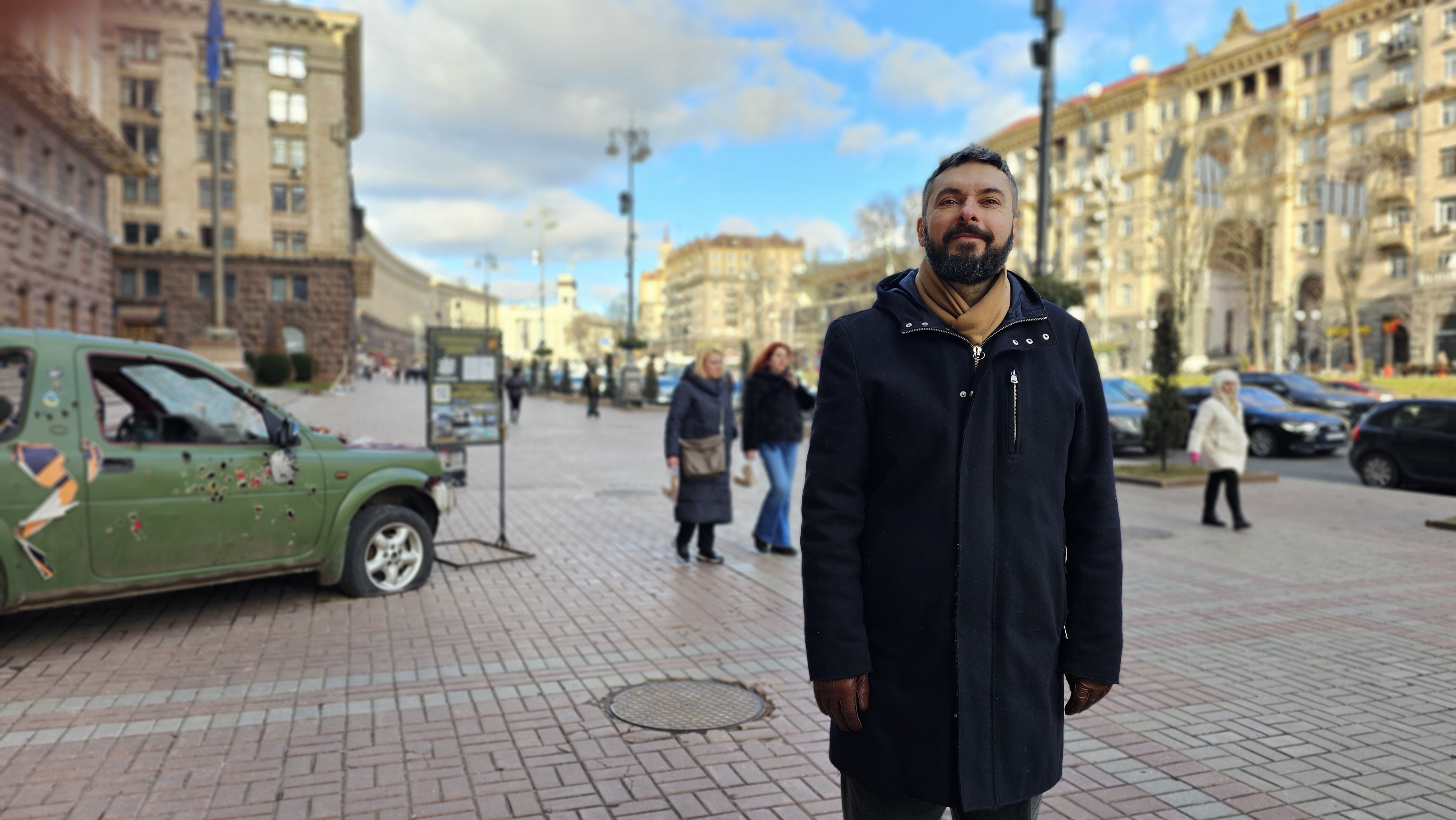
You might remember Max from the day of his liberation, a year ago, when after ten months in Russian captivity, he was returned to Ukraine. That day, a photographer captured the moment when Max was looking at an apple in disbelief and awe, having not seen fresh fruits or vegetables during his whole time of detention.
Last year, on the picture, he was looking gaunt, having lost 32 kilos during his ordeal. Shaved, skeletal, he was nothing like the tall, healthy-looking man who stood in front of me. The wounds run deep, he still have to deal with injuries both physical and psychological, but he is alive, and safe, for now.
It is almost a year to the day since he was freed, and I have a thousand questions, and the fear that each of them could cause more damage by reviving all the trauma. I know that I shouldn’t show emotion, in order to not make it worse. I know that I should not feel as much as I do, because it is not my place, but that particular day, I feel more intensely than usual, and I know it from the moment I leave home to meet Max. I feel the pressure and the privilege of being able to hear and share his story: we all want to know how he, and any other person who survived this ordeal, is doing right now. We all have those thousand questions.
Only, how do you ask them? How do you ask someone to share the unspeakable?
I don’t think there is a roadmap. What there is though, is very simple: we are many things, me a journalist, having moved to Ukraine, a learner of the country, and an ignorant of war until recently. Max, a civilian turned soldier, returned to civilian life for now, a husband, a father, a victim and a witness of the harm caused to his country, to his people and to himself, by the aggressor neighbor, now sitting here at a café table with a coffee and a macaron in front of him. My first thought is that I would like him to have all the macarons in the world for the rest of his life, every day, as if that could erase the ten months of privations. What there is, is very simple: humanity, as two people simply sit in front of each other.
And then we start talking. We start from the moment when Max, a civilian but also a reservist born in Donetsk, joins the army again. His battalion was surrounded in Kyiv region at the end of March 2022, and dozens of soldiers were captured. His ordeal starting March 20th. What he tells me is something I only ever read about. The pattern of abuse, beating, tormenting, reminds me of what a survivor of Russian torture in Balakliya, in Kharkiv region, was saying, but on a way larger scale. You can’t listen to such things without feeling you are having a bad dream, a dream you can’t wake up from because you are already wide awake. Several times, I am shocked not just by what Max went through, but by the casual aspect of the torture routines he describes, until Max says “one moment, please…” and looks for the exact word in English for the feeling he wants to express: “Absurd! It was absurd…” he says.
The banality of evil is here, right here. Everything he explains reminds me of what Charlotte Delbo or Primo Levi described when talking about concentration camps. The malnourishment – two large cups of clear soup with sometimes a leaf of cabbage in it, the randomness of “punishments”, people being chosen at a drunken guard’s will to be beaten up or tazed, hundreds of squats or push-ups having to be made by already frail prisoners, civilians and soldiers alike. And the utter ignorance of guards and officers alike when it came to Ukraine, assuming it was as backwards a place as the ones they came from, and assuming Max was constantly tormented in Kyiv because he came from Donetsk. thinking that because Max came from Donetsk, not believing him and other prisoners that Ukraine was a country where people had, prior to the war, an actually nice life.
With every word describing life in captivity, I understand that we are beyond the limits of reason, not to mention way past the respect of international law, and that the only difference I see with the concentration system of WW2 is that Russian prisons are not extermination camps – they are places where the individual is meant to be broken, emotionally and physically, subjugated, and forced into submission and admission that Russia will crush all of its neighbors. As months go by, the violence eventually decreases, minus some outbursts, because even tormentors understand that those prisoners have more value alive than dead.
Throughout our conversation, Max sometimes holds his cup of coffee, and I see the same hands as the ones that held that apple a year ago. Those hands could be those of any of my friends, and like the hands of thousands of civilians turned soldiers after February 24th. They are the hands that held a phone for the first time in ten months on February 4th, 2023, to dial in the number of his wife Julia, the one number he knew by heart, and he could finally hear his love after all that time, and tell her he was free. Max got lucky to come home, he now can hold his family, his wife and his daughters, his parents, tight in his arms again. He told me that he had been so worried to lose his ageing father during captivity, and to remain imprisoned for years.
After everything Max told me, I have one question: how did he manage to remain sane all that time? and again, the answer is very simple: because he is human, and along the dozen other prisoners in his cell, they kept each other sane by sharing stories, recounting nice moments of their lives, exchanged recipes of their favorite foods, looking forward to the next time they would be able to eat it. Those very thoughts of the love they knew existed, contributed to keeping them alive. All of this was stronger than the abject mediocrity and casual violence they were subjected to.
What is there to say, and what is there to do after having been through that, and having recounted it? Max and I look at each other, he asks me why I decided to come to Ukraine. I share my story as well, and now both of us have tears swelling in our eyes. It’s not sadness. It’s very simple: it’s our humanity.