A Journey Through War and Love, Now Interrupted: The Kyiv to Kramatorsk Route

The Kyiv–Kramatorsk train can’t run up to its final destination anymore. The final stops of Sloviansk and Kramatorsk have become too dangerous, as Russia now targets railway infrastructure all along the frontline.

I was on board this train often, and each time, it was an important lesson in what this war is about.

What is that journey about? A Kyiv-Kramatorsk journey begins very early, with an alarm clock ringing at 5 a.m., and a race to Kyiv’s main station to catch the Kramatorsk-bound train which departs, still, at 6:44 in the morning, sharp, no matter what. At dawn, hundreds of people with red eyes—from crying, from exhaustion after a night of Russian air raids—hop on or say goodbye to their cherished relatives who are going on board.

It is called the “Love train” because it links families to their loved ones, from across the country, from the rear to the frontline, soldiers with their lives, in many ways. It is a war train. On the racks, camouflage bags in all shades of green show the presence of servicemen returning from permission. Chevrons show legendary brigades fighting in the direction of Lyman, Kostyantynivka, and Pokrovsk.

As the train departs, the sun rises and basks the statue of Mother Ukraine in a beautiful pink light, or wraps her up in a fog, depending on the weather. The train lulls us away from the capital. It is quiet, apart from the back and forth of the coffee-trolley that circulates across our carriages.

At 9 a.m. sharp, the daily minute of silence and the stern countdown in memory of all the people who gave their lives defending Ukraine plunges each carriage into an atmosphere of deep and quiet reflection. Some people stand, others just bow their heads. In Ukraine, everybody knows in their flesh the price of blood paid for the country to remain free.

On board, everybody is involved in the war: humanitarians, journalists, soldiers, and their families. Yet it is a train full of life: each ride brought back home dozens of people uprooted from Donbas and coming back to visit their relatives left behind, a handful of humanitarians, and dozens of wives, girlfriends, and children of soldiers.

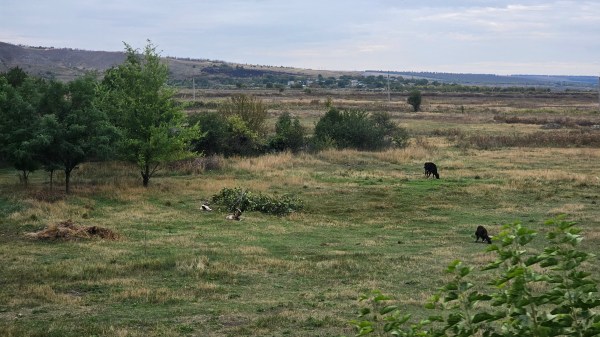
Landscape of Kharkivska Oblast, a hill in the background, the sky is cloudy but luminous.
Cattle is in a field in the distance.
Kharkivska Oblast as seen from the Kyiv-Kramatorsk train © Emmanuelle Chaze, July 2025

Riding this train, slowly heading towards Donbas, through the hills of Poltava and the vast fields of Kharkiv Oblast, is a travel through Ukraine’s rich landscapes and a travel through its history.

The closer one gets to Donbas, the more visible the war becomes. As the scenery passes by the window, it fills with ever more grey, dark green, and all shades of military vehicles that drive towards or come back from the frontline.

There are scenes of ordinary lives: babusias on their bicycles, mothers in pink hoodies walking their toddlers.

Then there is the Ukrzaliznytsia message upon arriving in Kramatorsk: “Thank you for your support. Our trains are getting ready to return to Donetsk, Luhansk… see you soon on Ukrainian railways.”

Each time, arriving in Kramatorsk felt like it could be the last. Earlier this summer, seeing the Lozova station in ruins foreboded the worst: it was only a matter of time until the Kyiv–Kramatorsk would stop running up until its final stations.

At each station, emotional reunions of families and lovers took place on the platform. But the most moving of all happened in Sloviansk and Kramatorsk, as the train finally came to a stop and the doors opened. At this moment, time stopped. We all knew one has to walk away from the station as quickly as possible, as it is Russia’s target of choice. Yet, time stopped right here. Tired but happy-looking men in military clothes, of all ages, welcomed their wives, fiancées, and girlfriends with tight embraces that let all their exhaustion and relief transpire. So many tears, most of happiness. Each hug is a victory against the aggressor. Each reunion a blessing for one soldier and his family.

Finally, love. Finally, this long-awaited hug. Love, through blood and sweat, and the smell of Ukraine’s soil and its hundreds of posadkas, the hiding lairs where tens of thousands of Ukrainians shelter along the frontline.

Love, the only thing that still makes sense. The one thing everybody fights for. This love persists, despite all this blood, all this misery, all this horror. All those killer drones.

The Love train no longer brings together lovers on Kramatorsk’s platforms. It is a tragedy. It was a handy commodity for thousands of customers.

But to think that love can be stopped because of the aggressor would be to grossly underestimate what Ukrainians are capable of—what love is capable of.
Life will be tougher for soldiers in that sector; travel will become even more uneasy.

But there will be other routes. There will be other reunions. And there will be love, always.
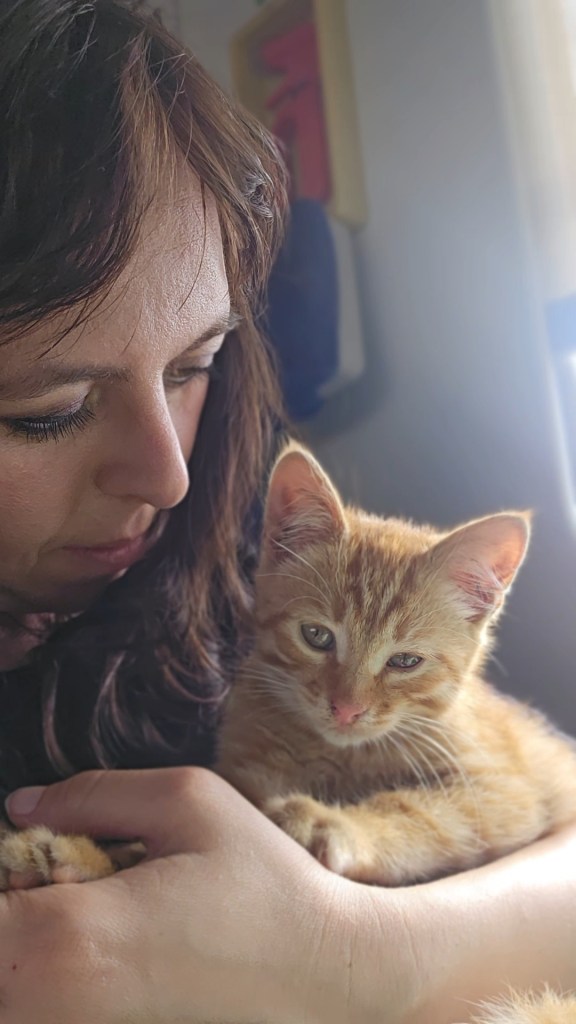
The author holding a ginger cat while on a Kyiv Kramatorsk train
A frontline kitten being evacuated from the frontline towards a Kyiv life © Emmanuelle Chaze, summer 2025

The darkness around us

Podil was hit badly two nights ago, it was the second night in a row that we had been having strikes in the city center. Considering, anybody living in the heart of Kyiv is very privileged: we can enjoy a relatively normal life most of the time. Except when Russia strikes.

The following day, when I asked my friend Katya, who lives in that district, if she was ok, she told me that everything was fine with her. I was dealing with my own trauma that day, reporting on the death of two journalists, murdered by Russia with a drone, in Kramatorsk, a city I know well, a city which I know faces the same fate as too many others in Donbas before: Chasiv Yar, Pokrovsk, Toretsk, which you, reading me in English, might know only through pictures of their utter devastation. But those places didn’t use to be ashes, they used to be full of flowers, and full of life, until Russia came and levelled them to the ground.

So after reporting on the death of Olena Gramova and Yevhen Karmazin, I felt nothing but emptiness. Somehow, this particular murder hit me, my hands were shaking uncontrollably. I didn’t know them personally, I knew them through their work. I shelved the ton of reports I was supposed to hand in because I simply could not think, let alone write. I watched one of their reports, embedded with an NGO evacuating civilians in Donbas, something they filmed in March this year. Under Russian attack, they follow an NGO in Kostyantinivka now evacuated hospital. I can’t help but cry when I see that this video got a little more than a thousand views since its publication in March. Those are colleagues who day in, day out, risked their lives on the ground, close to the red zone, to report on Russia’s crimes against Ukraine.

But back to Kyiv. Today I was chatting to Katya’s sister, on a completely different topic (namely, why does a Kramatorsk hospital still invest in a 5 million hryvnias top-notch new X-ray machine when the city is being bombed daily and whether this will ever make sense), and she let slip that she is very stressed out “given what happened to Katya”. Follows a moment of confusion, what have I missed? It turns out that Katya’s building got hit with shrapnel that night. I write back to Katya. “and you told me you were fine?!”. She answers “well, I’m fine, and the windows shattered were on the other side of the building, and I’m alive, so, considering, yes I’m fine”. I’m both relieved and appalled. This is neither fine nor normal, yet it is our reality.

This week, on October 20th, 84-year-old Larysa Vakuliuk, a goat herder from Kherson region, got targeted and killed, alongside her two goats, on a country road by a Russian FPV drone. It will never be said enough: FPV, First Person View, means that the pilot sees very well what, or who, he is targeting. Larysa had refused to leave her home, because she didn’t want to abandon her animals.

 In Chernihiv region, half of the population was plunged in a full blackout and emergency tents, “invicibility points”, had to be set up.

On October 22nd, in Kyiv region, Antonina Zaichenko, her six months old baby girl, Adelina were killed, alongside her 12 year old niece Anastasiia. The family had moved from Kyiv to the village of Pohreby, in Kyiv region, as they thought this would be safer. 

The same day, October 22nd, Russia launched a kamikaze drone on a kindergarten in Kharkiv. The 48 children present were apparently uninjured, but one man died, one person lost a leg (authorities communicated on a “traumatic injury resulting in amputation”, and another person suffered burns on 20% of their body”).

Back in Kherson, on October 24th, Russia also attacked the city with a multiple launch rocket system, resulting in three deaths and at least 14 injuries, and in Odesa region, Russia launched glide bombs, a first in this part of  Ukraine. 

This week, the numbing sound of diesel generators roar in most streets in Kyiv. It is deafening. Many shops, cafes and restaurants are plunged in obscurity. It is dark and cold, I am writing those lines wrapped in my coat, with the desk light flickering, and all my electric devices are charging, just in case. In the corridor, I have lined up water supplies, in case Russia hits again and deprives us from running water. Next to the bottles, a fire extinguisher, in case a drone, or worse, a missile, hits the building. A bag with my important documents and the cat transport boxes are ready to be grabbed in case I have to leave the flat in a hurry.

I am lucky to live in the safest area of Kyiv, a European capital which still shines in many ways, except not at night because now it’s mostly plunged in an unwelcoming darkness, and it does not feel safe anymore. As I am writing those lines, I ask myself, am I fine? I am, because I am alive and I still have all my limbs. My loved ones are alive. I get to write these lines. This is what we consider fine here. But if I answer the question “are Ukrainians fine?” (which they can answer themselves, please, please ask them directly), I would say, no, Ukrainians are not fine, they are surviving, although like every other being, they deserve to live safely, instead of seeing their country being ripped apart daily.

Website Powered by WordPress.com.

Up ↑