A Journey Through War and Love, Now Interrupted: The Kyiv to Kramatorsk Route

The Kyiv–Kramatorsk train can’t run up to its final destination anymore. The final stops of Sloviansk and Kramatorsk have become too dangerous, as Russia now targets railway infrastructure all along the frontline.

I was on board this train often, and each time, it was an important lesson in what this war is about.

What is that journey about? A Kyiv-Kramatorsk journey begins very early, with an alarm clock ringing at 5 a.m., and a race to Kyiv’s main station to catch the Kramatorsk-bound train which departs, still, at 6:44 in the morning, sharp, no matter what. At dawn, hundreds of people with red eyes—from crying, from exhaustion after a night of Russian air raids—hop on or say goodbye to their cherished relatives who are going on board.

It is called the “Love train” because it links families to their loved ones, from across the country, from the rear to the frontline, soldiers with their lives, in many ways. It is a war train. On the racks, camouflage bags in all shades of green show the presence of servicemen returning from permission. Chevrons show legendary brigades fighting in the direction of Lyman, Kostyantynivka, and Pokrovsk.

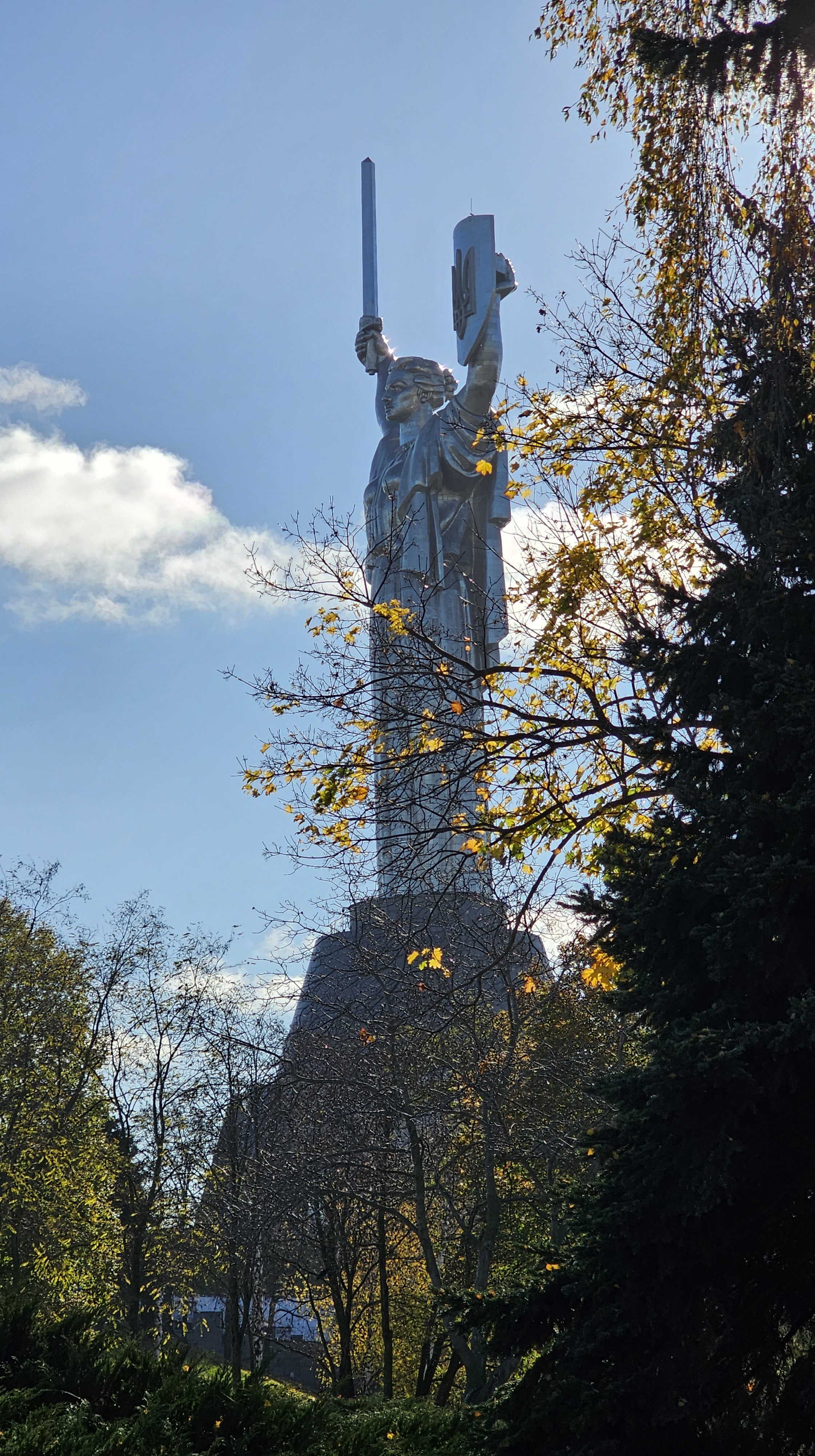
As the train departs, the sun rises and basks the statue of Mother Ukraine in a beautiful pink light, or wraps her up in a fog, depending on the weather. The train lulls us away from the capital. It is quiet, apart from the back and forth of the coffee-trolley that circulates across our carriages.

At 9 a.m. sharp, the daily minute of silence and the stern countdown in memory of all the people who gave their lives defending Ukraine plunges each carriage into an atmosphere of deep and quiet reflection. Some people stand, others just bow their heads. In Ukraine, everybody knows in their flesh the price of blood paid for the country to remain free.

On board, everybody is involved in the war: humanitarians, journalists, soldiers, and their families. Yet it is a train full of life: each ride brought back home dozens of people uprooted from Donbas and coming back to visit their relatives left behind, a handful of humanitarians, and dozens of wives, girlfriends, and children of soldiers.

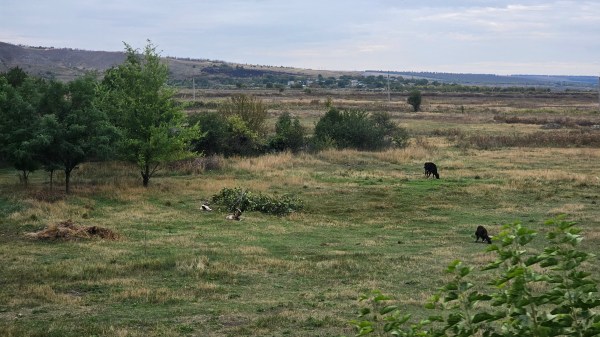
Landscape of Kharkivska Oblast, a hill in the background, the sky is cloudy but luminous.
Cattle is in a field in the distance.
Kharkivska Oblast as seen from the Kyiv-Kramatorsk train © Emmanuelle Chaze, July 2025

Riding this train, slowly heading towards Donbas, through the hills of Poltava and the vast fields of Kharkiv Oblast, is a travel through Ukraine’s rich landscapes and a travel through its history.

The closer one gets to Donbas, the more visible the war becomes. As the scenery passes by the window, it fills with ever more grey, dark green, and all shades of military vehicles that drive towards or come back from the frontline.

There are scenes of ordinary lives: babusias on their bicycles, mothers in pink hoodies walking their toddlers.

Then there is the Ukrzaliznytsia message upon arriving in Kramatorsk: “Thank you for your support. Our trains are getting ready to return to Donetsk, Luhansk… see you soon on Ukrainian railways.”

Each time, arriving in Kramatorsk felt like it could be the last. Earlier this summer, seeing the Lozova station in ruins foreboded the worst: it was only a matter of time until the Kyiv–Kramatorsk would stop running up until its final stations.

At each station, emotional reunions of families and lovers took place on the platform. But the most moving of all happened in Sloviansk and Kramatorsk, as the train finally came to a stop and the doors opened. At this moment, time stopped. We all knew one has to walk away from the station as quickly as possible, as it is Russia’s target of choice. Yet, time stopped right here. Tired but happy-looking men in military clothes, of all ages, welcomed their wives, fiancées, and girlfriends with tight embraces that let all their exhaustion and relief transpire. So many tears, most of happiness. Each hug is a victory against the aggressor. Each reunion a blessing for one soldier and his family.

Finally, love. Finally, this long-awaited hug. Love, through blood and sweat, and the smell of Ukraine’s soil and its hundreds of posadkas, the hiding lairs where tens of thousands of Ukrainians shelter along the frontline.

Love, the only thing that still makes sense. The one thing everybody fights for. This love persists, despite all this blood, all this misery, all this horror. All those killer drones.

The Love train no longer brings together lovers on Kramatorsk’s platforms. It is a tragedy. It was a handy commodity for thousands of customers.

But to think that love can be stopped because of the aggressor would be to grossly underestimate what Ukrainians are capable of—what love is capable of.
Life will be tougher for soldiers in that sector; travel will become even more uneasy.

But there will be other routes. There will be other reunions. And there will be love, always.

The author holding a ginger cat while on a Kyiv Kramatorsk train
A frontline kitten being evacuated from the frontline towards a Kyiv life © Emmanuelle Chaze, summer 2025

Under Mother Ukraine, the History of Ukraine during WW2

I had wanted to go to the Museum of the History of Ukraine during the Second World war in Kyiv for quite some time, but the current war always got in the way. I managed a few weeks ago, and there were many, many interesting aspects to talk about.

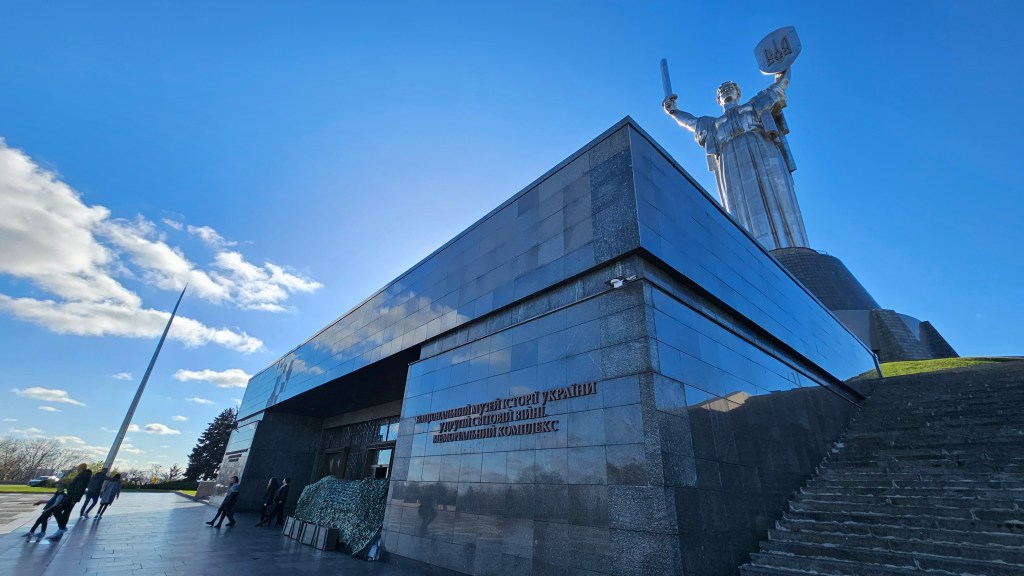
Entrance of the museum of the history of Ukraine in the Second World War in the foreground. In front of it, some sandbags and ammunition boxes. Some visitors are seen exiting the building. In the background, statue of Mother Ukraine.
The Museum of the History of Ukraine in the Second World War in Kyiv © Emmanuelle Chaze, Kyiv, November 2023.

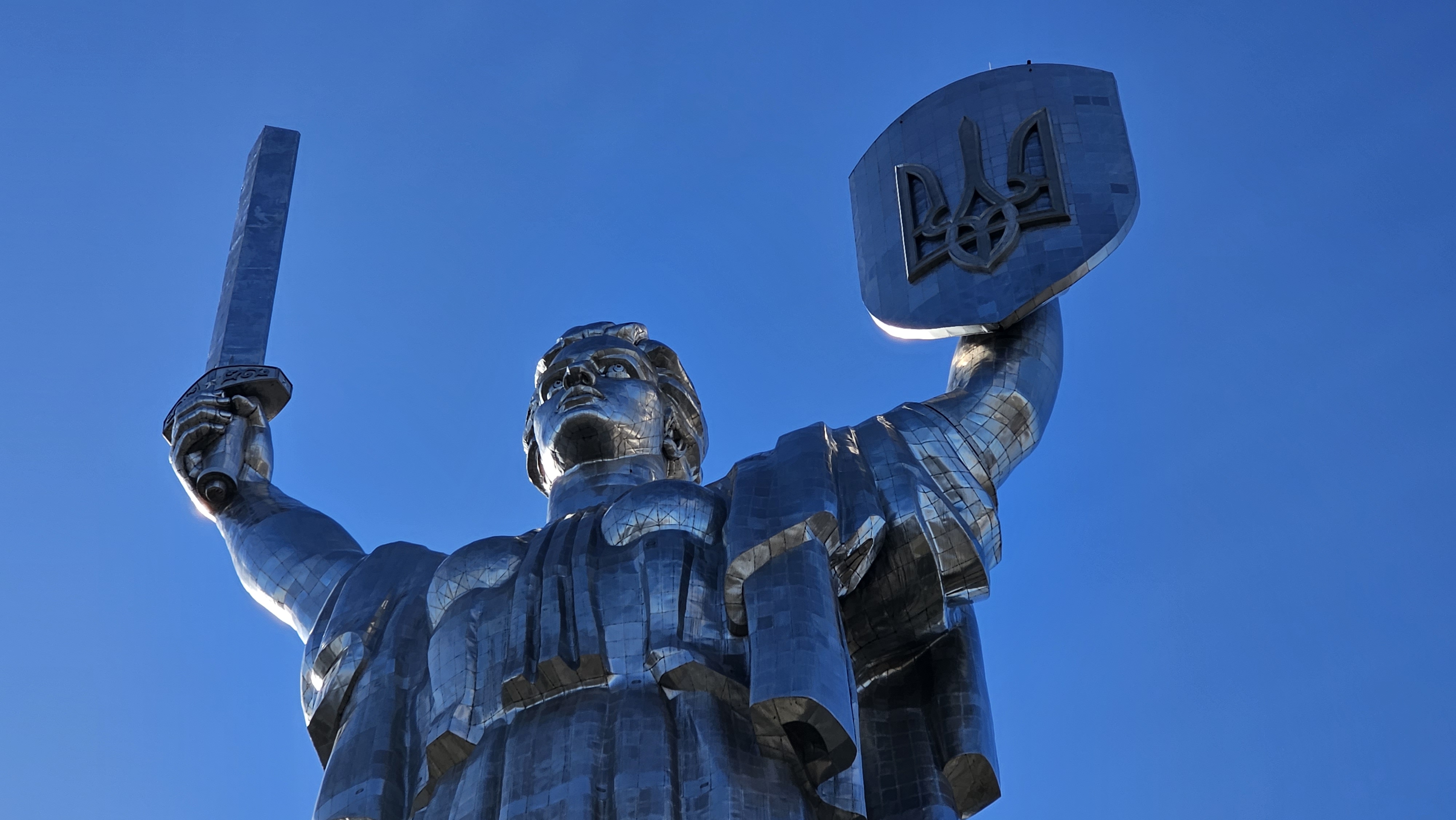
First of, for those unfamiliar with Kyiv, the museum itself is located under the monumental Mother Ukraine, Україна-мати, a 62m-tall (102m if you count its base) Soviet-era titanium statue built in 1979 as a war memorial. Its two sculptors were both born in Dnipro: Evhen Vuchetych, who died in 1974 and is also the designer of the Soviet War Memorial in Treptower Park in Berlin, and Vasyl Borodai, who completed the project.

You might have heard that Mother Ukraine got a decommunisation make-over on August 1st, 2023, when the Soviet crest, showing the hammer and the sickle, got removed to the benefit of the beloved (here) Ukrainian tryzub. Although this was years in the making, since Soviet and communist symbols were outlawed by the Ukrainian Parliament in 2015, a referendum held in July 2023 showed that an overwhelming majority of the citizens consulted were in favour of getting rid of the Soviet symbol on Mother Ukraine’s shield.

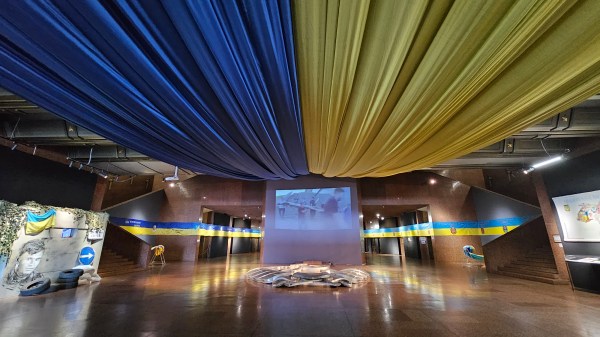
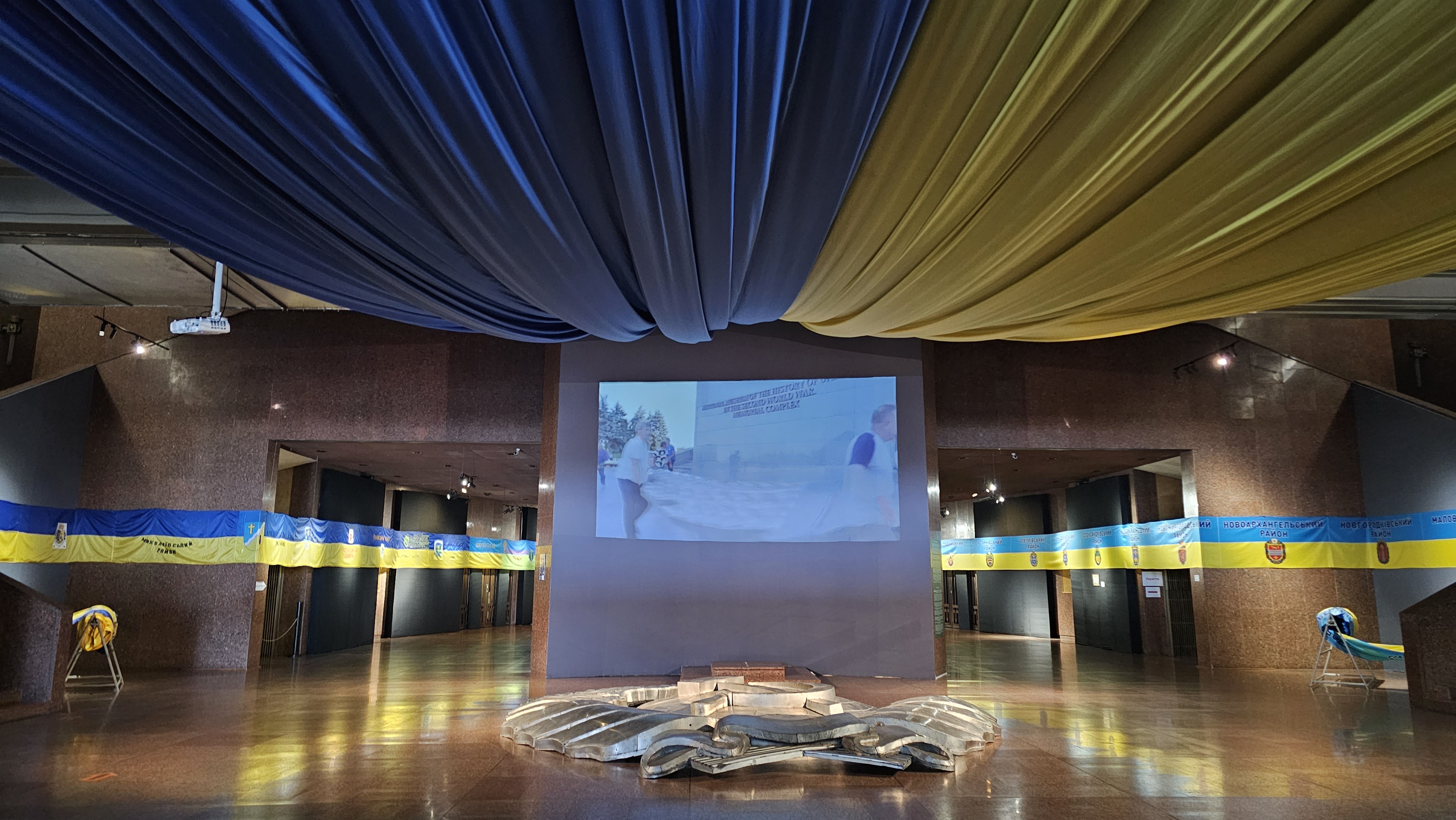
To illustrate this sentiment, my first sight upon entering the museum was that of a Ukrainian soldier giving a disdainful kick in the Soviet Crest, now exhibited in the entrance hall, but looking belittled by an immense blue and yellow flag engulfing the entire ceiling.

In the same hall, the monumental architecture is entirely subdued by Ukrainian identity. Ukraine now is reappropriating itself spaces of propaganda, and the museum of World War II is one shining example of that effort made for Ukraine to decommunize, decolonize and redefine its history from a Kyiv-centered, and no longer from a Moscow-centered perspective.

In the darkness of what used to be a Soviet architectural token, Ukraine has managed to make shine not only its beloved flag, but also its history, which it is now intent on separating from that of the agressor.

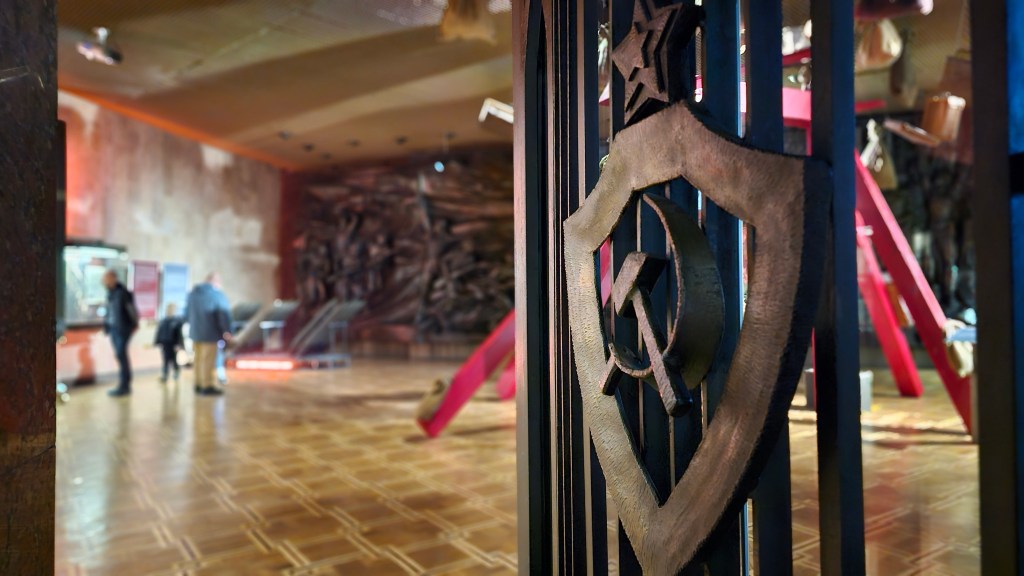
Some signs of Soviet times might still hang on the iron doors, but inside the museum, the Kyiv- and not Moscow-oriented history of Ukraine is on display © Emmanuelle Chaze, Kyiv, November 2023

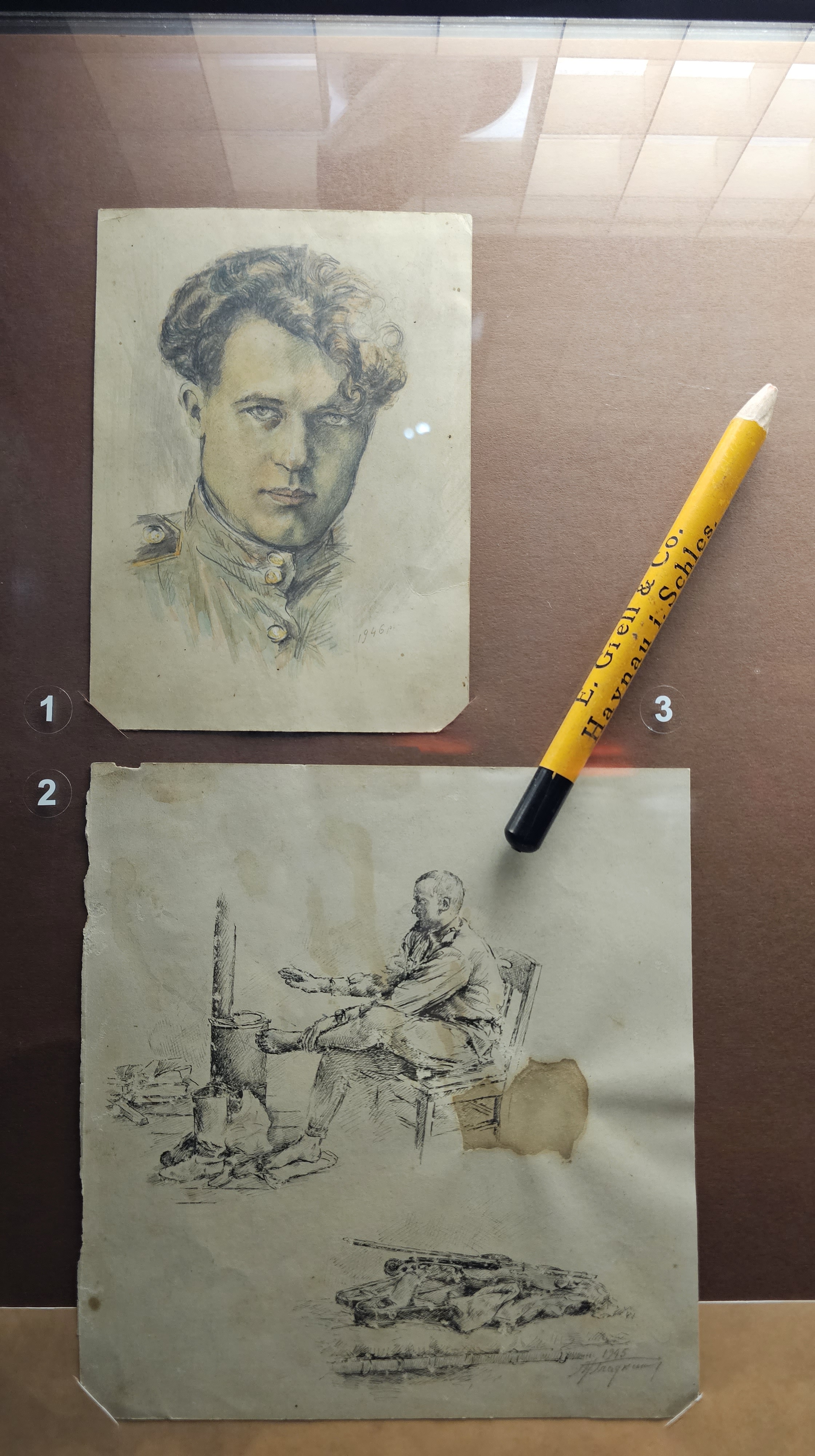
In one of the rooms, artifacts retrieved from the battleground and families’ archives give an idea of what everyday life was for a Ukrainian soldier, not unlike the possessions of soldiers currently fighting.

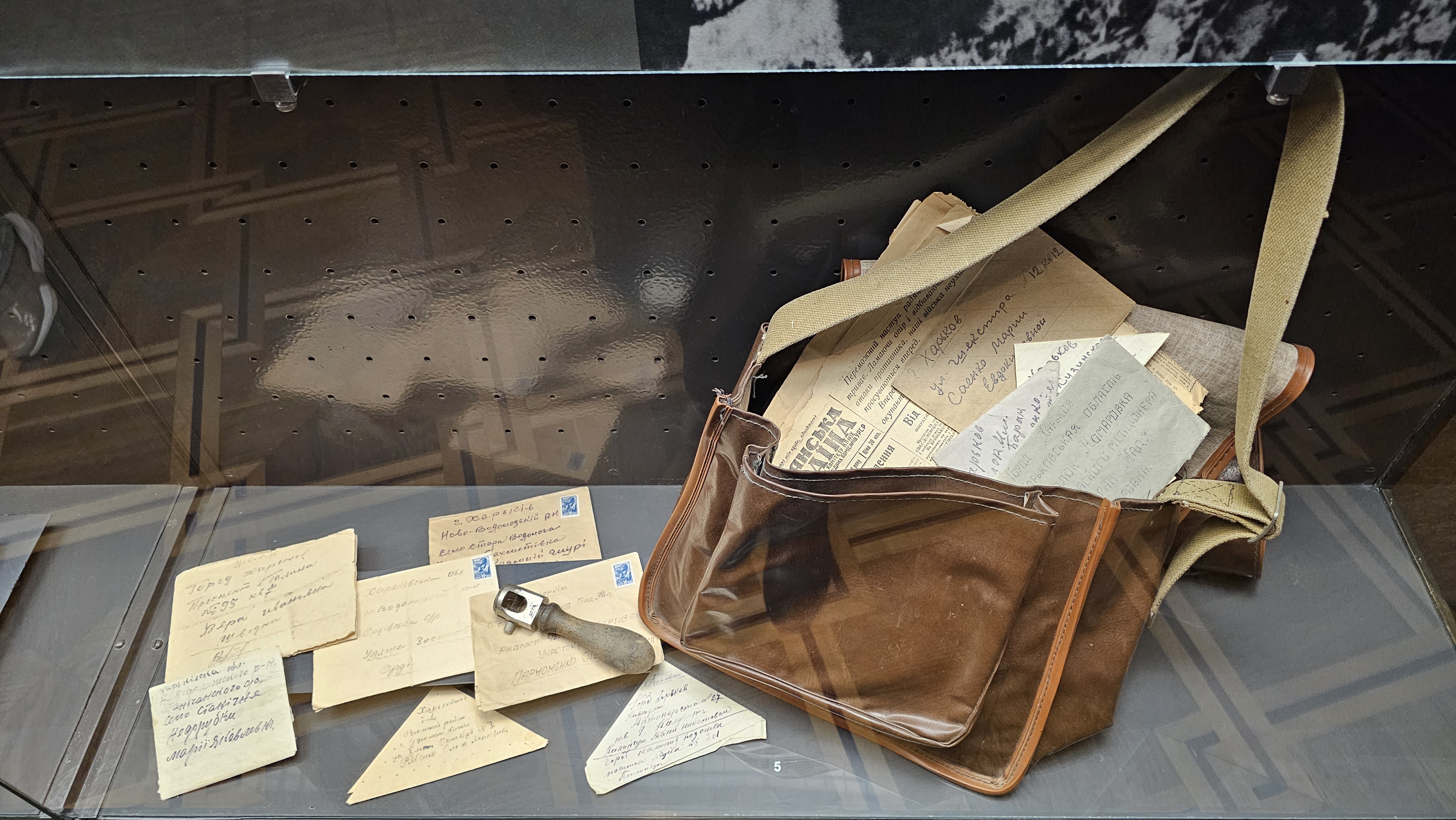
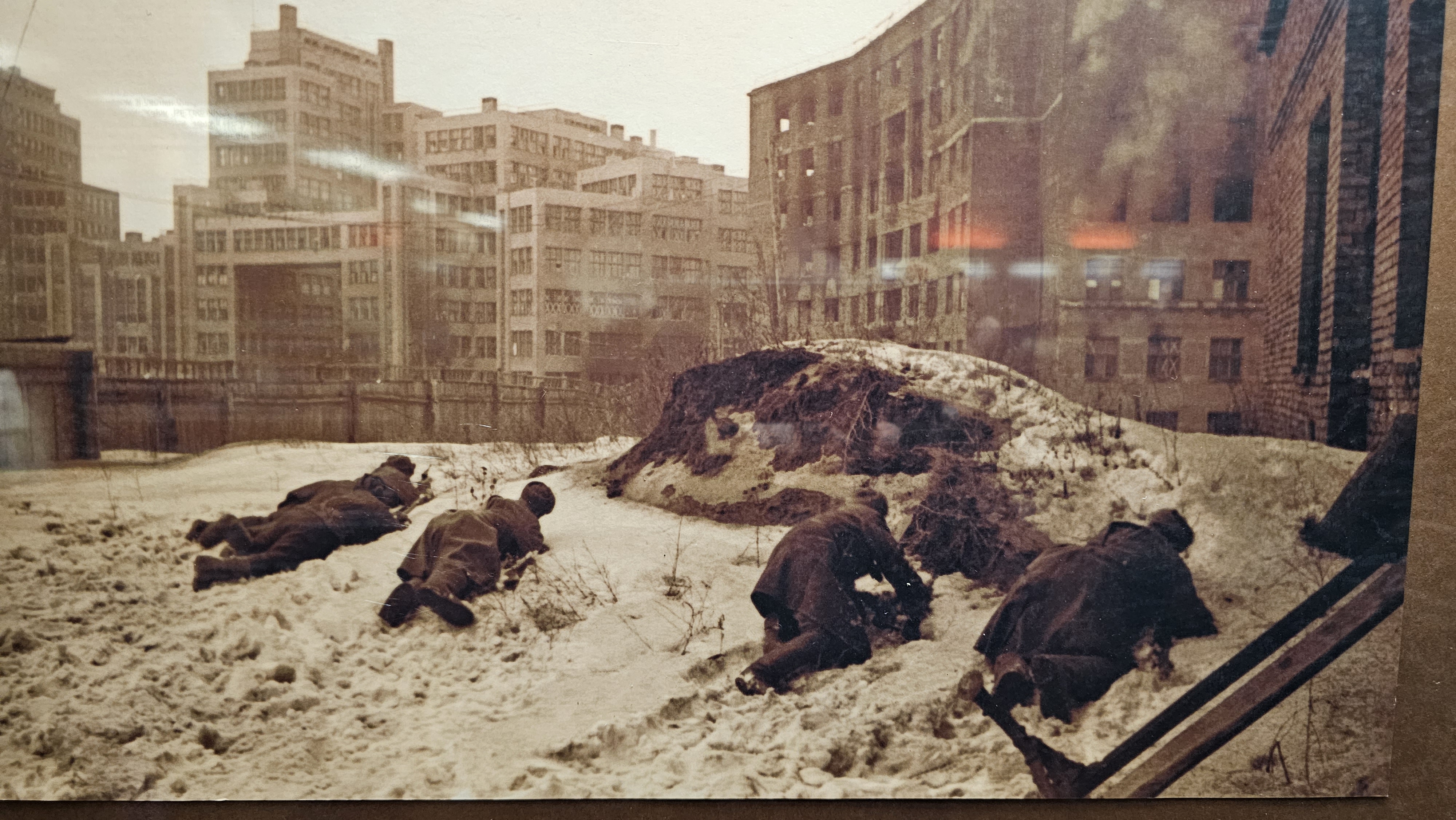
A vitrine showcases pictures of burnt cities. Kharkiv destroyed. Kyiv destroyed. Again, not unlike the current aftermaths of Russian shellings. There are also birth certificates – they emphasize the regrowth of the country. A very moving display shows a postman’s bag with letters from soldiers that never reached their recipients. They were written in Kharkiv region in June and July 1941. A team of researchers is still trying to find surviving family members and hand them over, if 80 years delayed. 660 copies of letters have been handed over to relatives, and the research continues to find recipients of the several dozens remaining.

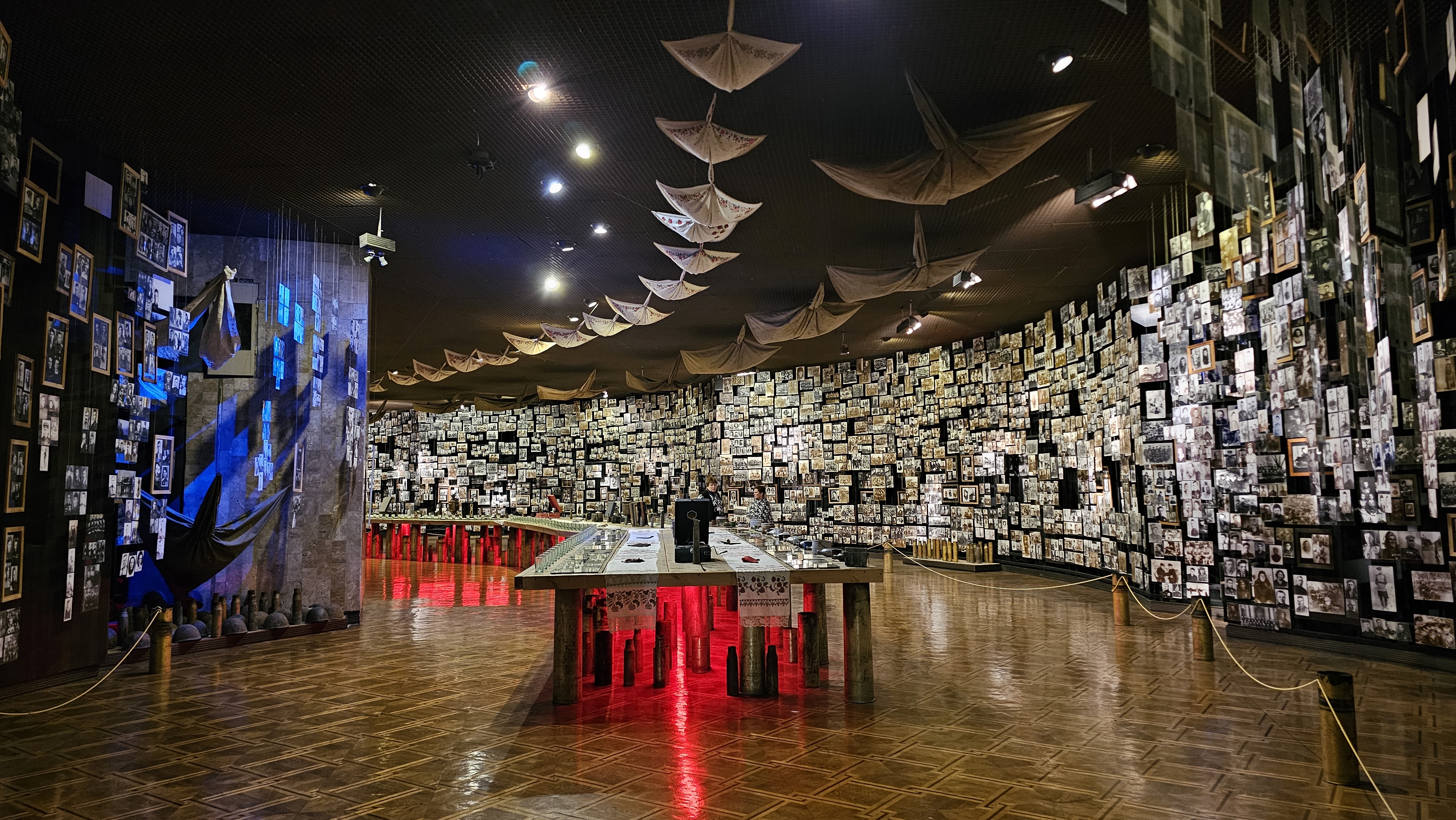
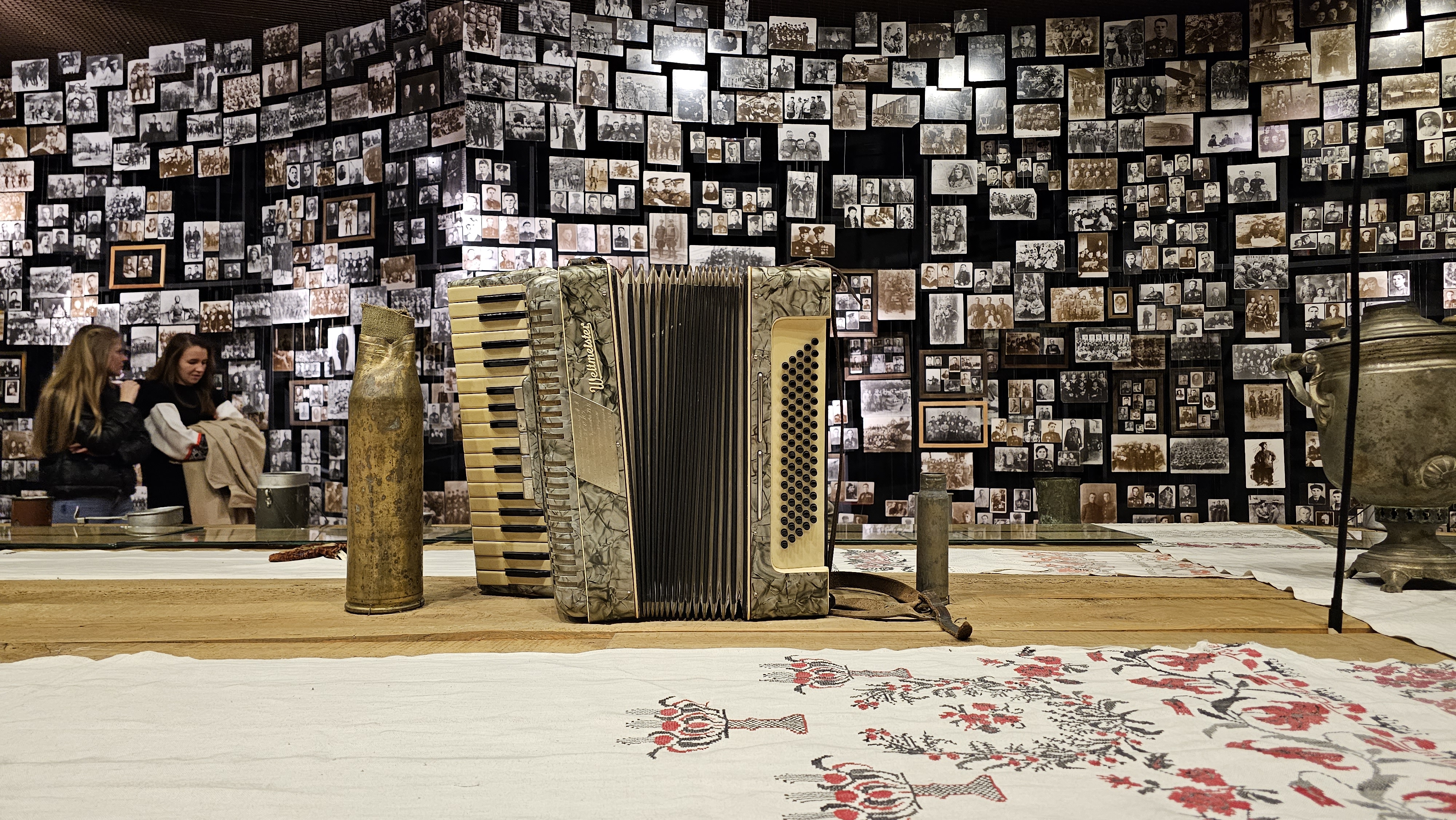
In another room, the monumental architecture is matched by an equally monumental display of thousands of pictures retrieved from family archives: ad infinitum, “The Wall of Memory” depicts thousands of soldiers, “a collective portrait of a generation that has suffered the bloodiest war in history. There people were in different armies, under different flags, some returned and some remained lying in the soil on the land for which they fought until the very last”, reads a sign.

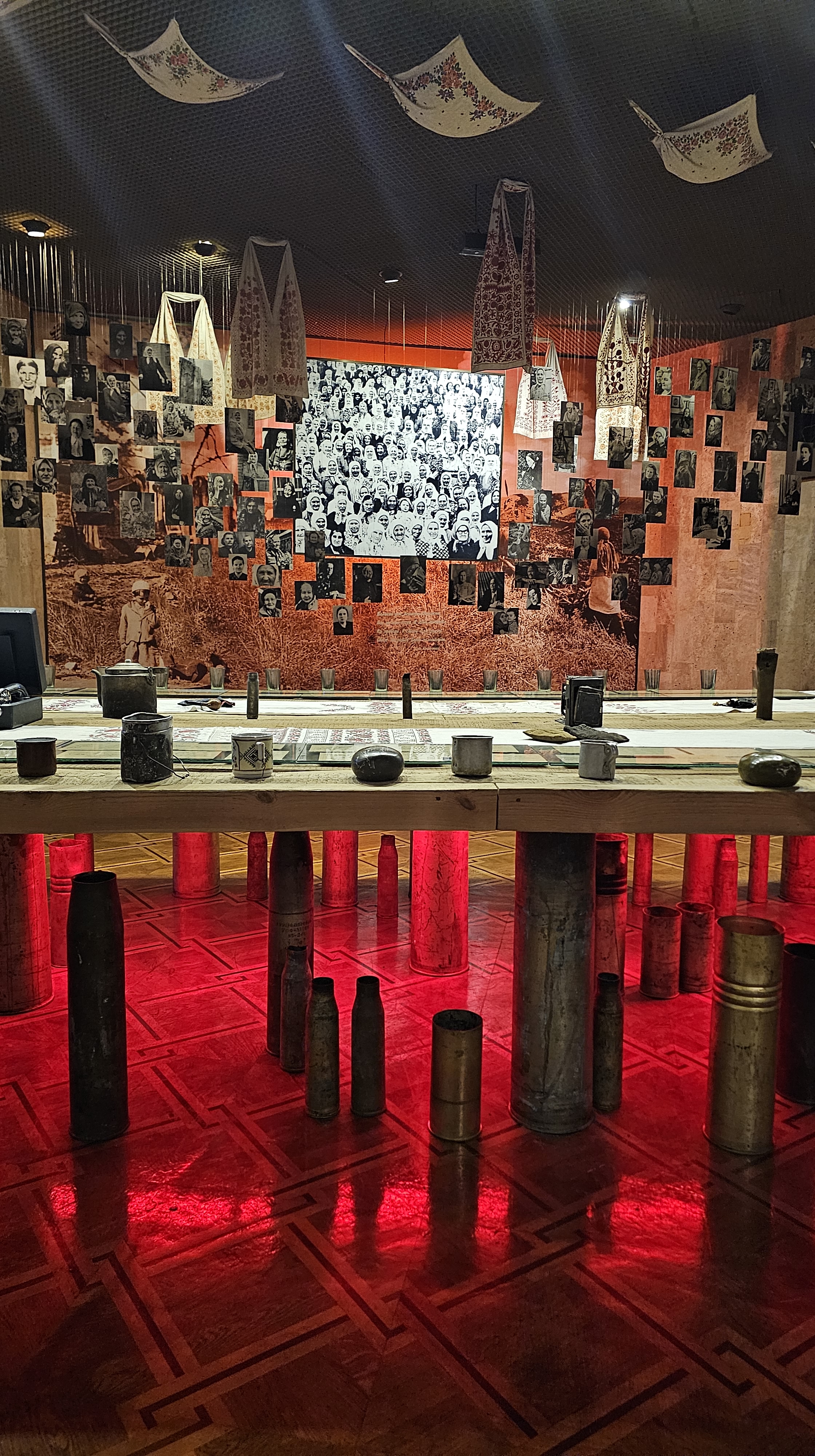
Along music instruments and a long banquet table where funeral letters are displayed in a macabre last supper formed by soldier’s mess tins and a few music instruments, the display is a reminder of the humanity lost in what historian of Ukraine Timothy Snyder calls “the bloodlands”.

Like a solemn reminder to contemporary Ukraine, the sign reads further: “We are the memory we keep. The attitude to human life as the highest value determines the maturity and civility of a nation. Therefore, the memory of the Ukrainian people about the war is the memory of each lost and destroyed life.”

At the Museum for History in the making

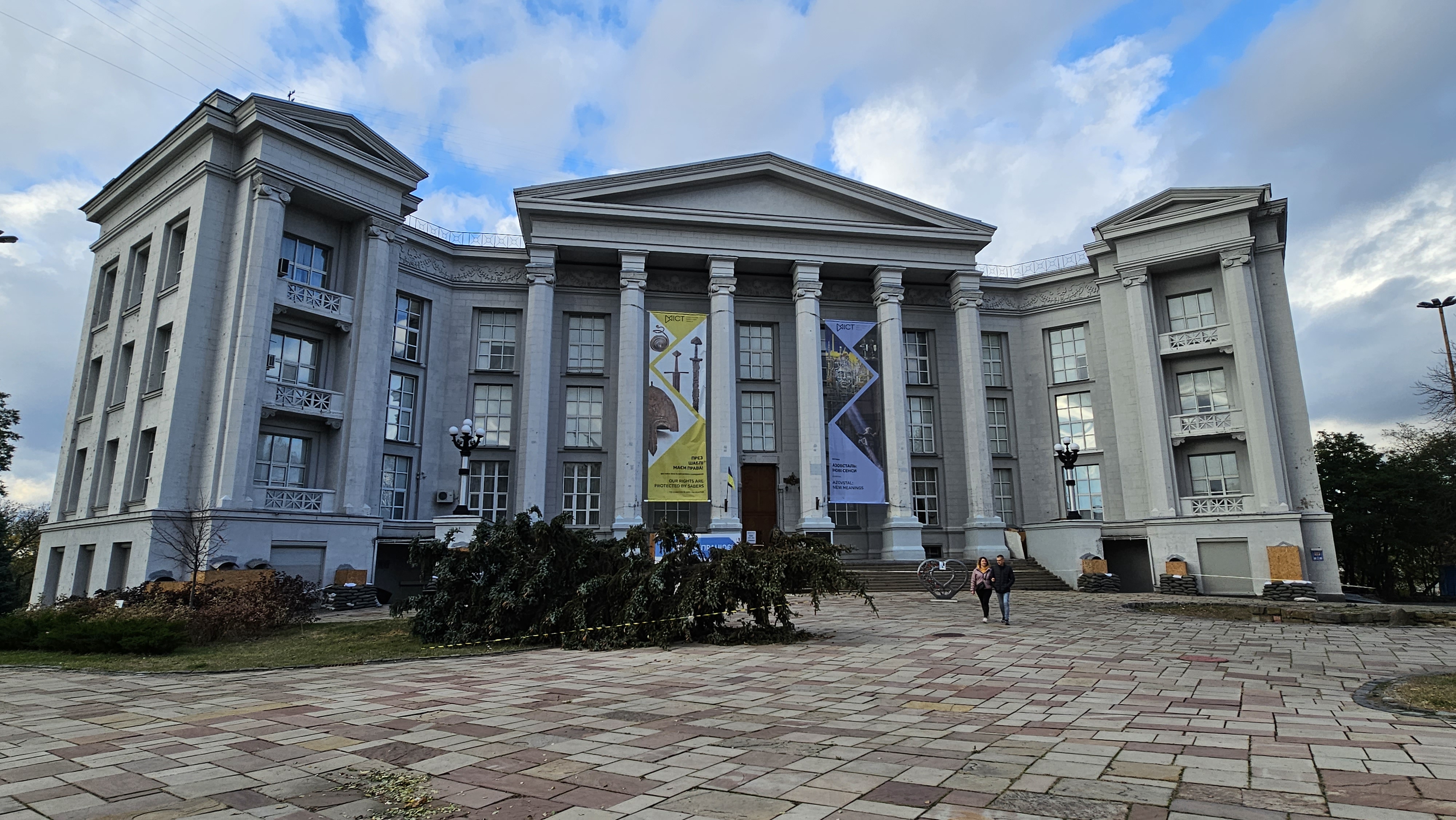
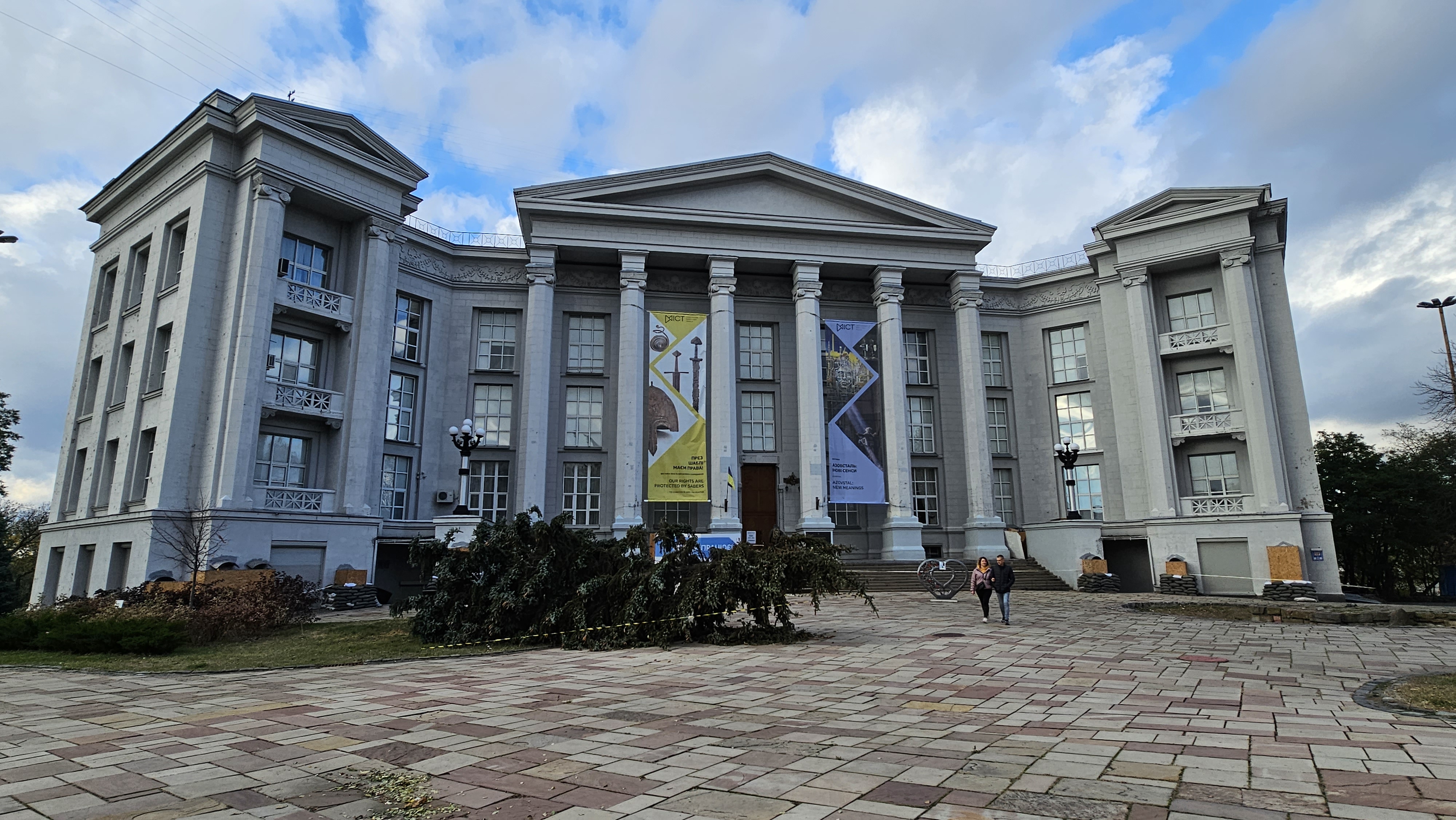
In the very heart of Kyiv, just next to the ruins of the Tithe Church, the first religious building made in stone in the slavic world, dating back to the 10th century, you can find the monumental National Museum of the History of Ukraine. Its basement windows are still sealed with sandbags and wood panels, but its huge windows on the upper flows are rid of protection, not even showing signs of tape, generally used in times of war as a precaution to minimize the damages caused by shards, in case of explosions. Despite the war, the museum is open, but how does one speak about the history of a country, when one of its bloodiest chapters is still being written? How to make sense of the chaos in which the country sank since 2014, and even more so since February 24th, 2022? Since the beginning of the full scale invasion of Ukraine, dozens of cultural institutions, historic sites and religious buildings have had to close or displace their collections, so as to shelter a heritage that is also targeted and destroyed by bombs and by the Russian occupier.

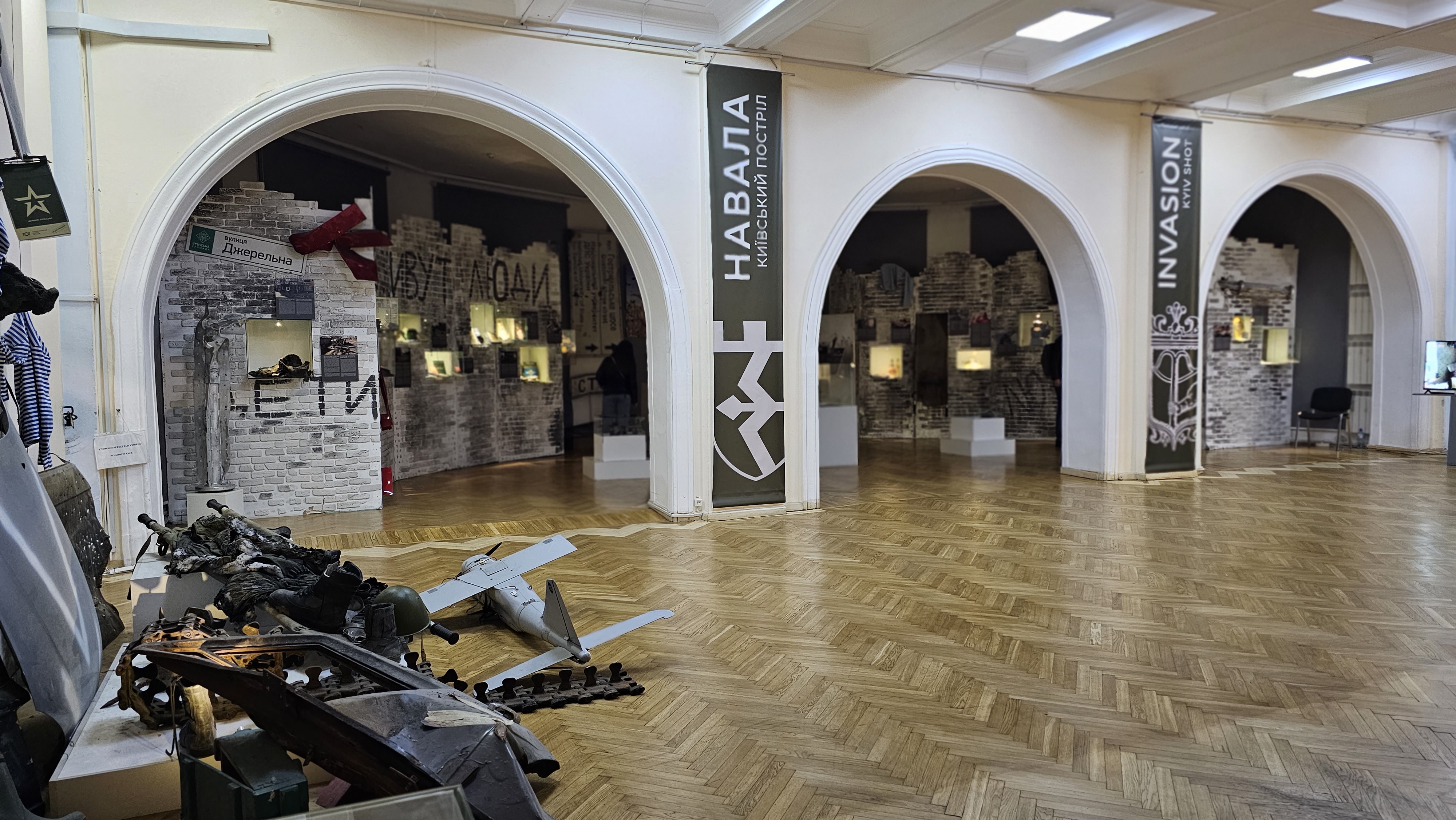
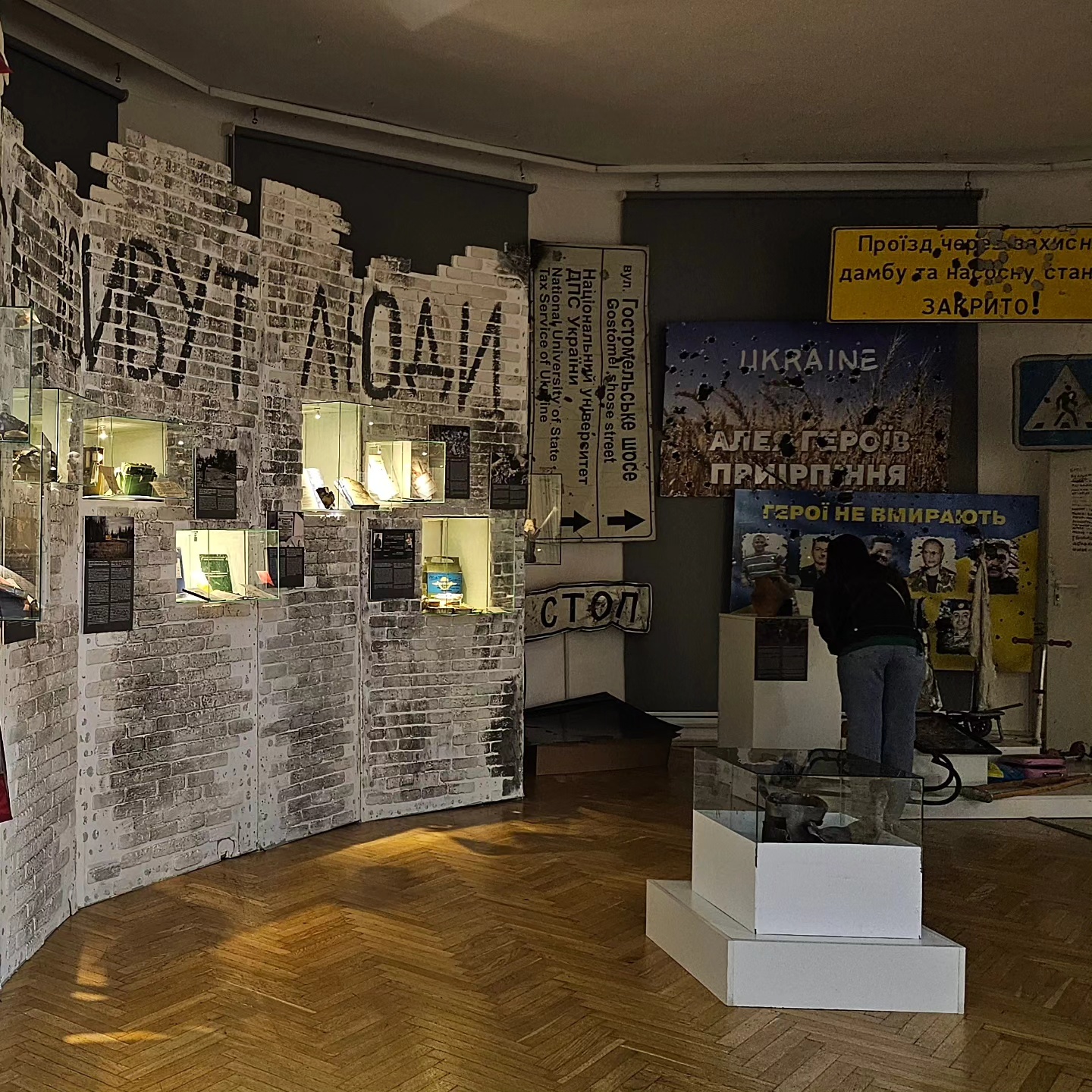
Opening a museum’s doors is thus an act of resilience, but one that can’t be done without including in the collections the very contemporary history of the country. It is the purpose of the museum itself, at a time when the identity of Ukraine is threatened to its core, and it is clear from the very start, in the entrance hall, where exhibits of the violence of the Russian agression and occupation of the Kyiv region line up in a very concrete display of what we have heard of, or seen.

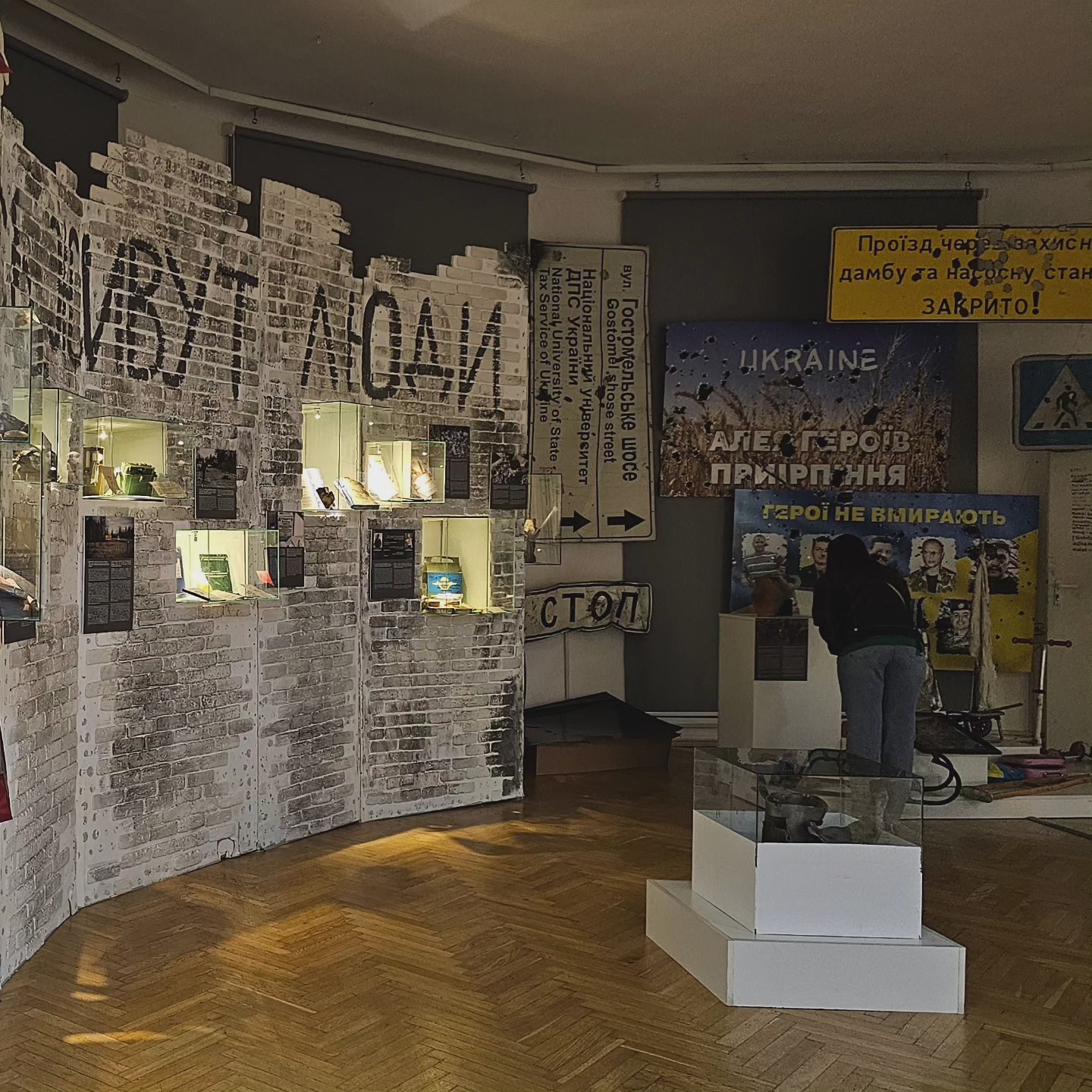
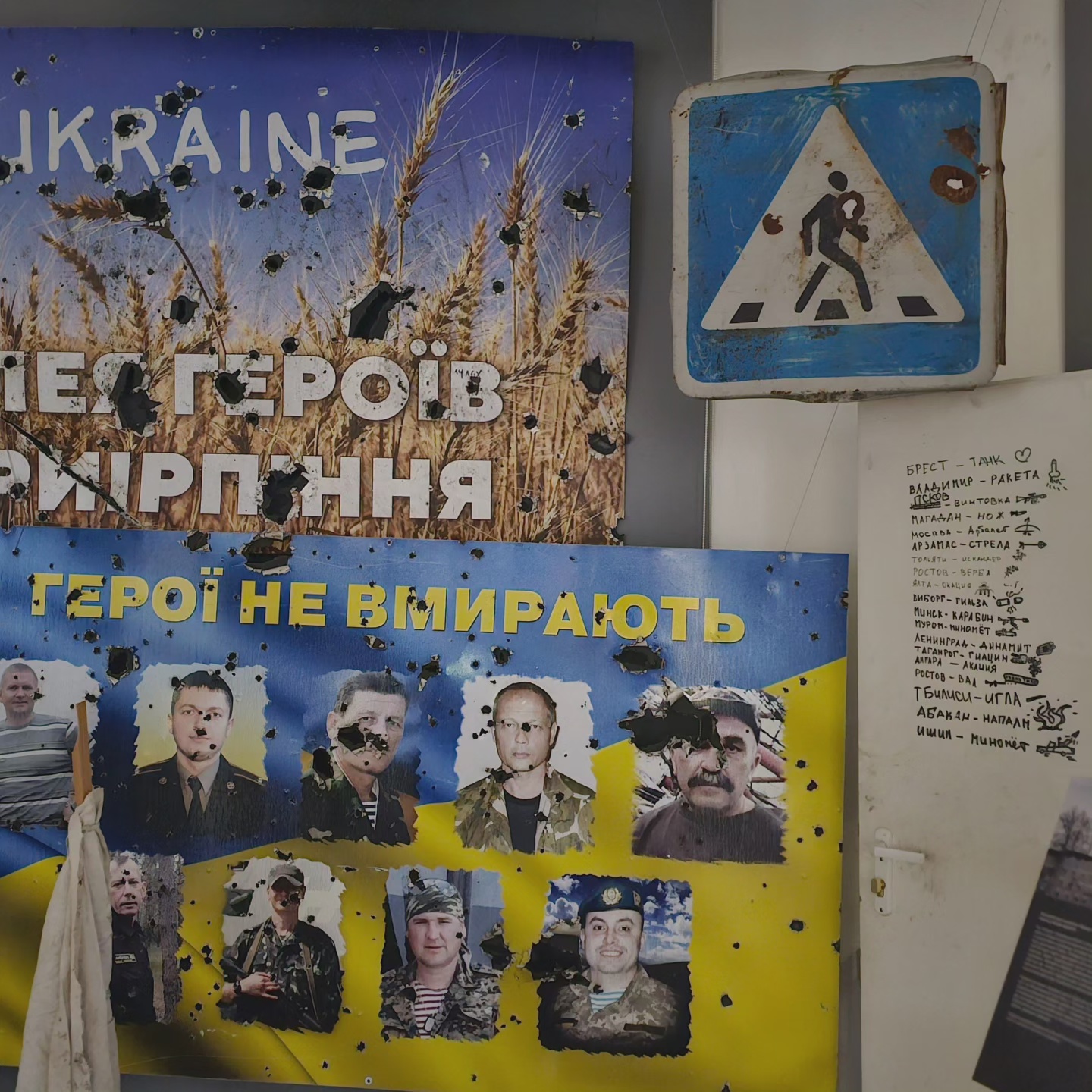
Shrapnels, rocket shells, bloodied stretchers, street signs pierced with bullet holes, and damaged plaques commemorating the « Heavenly hundred », the fallen protesters killed in Kyiv’s street during the Maidan Revolution in February 2014. Belongings of ennemy soldiers reveal many things: they used road atlases from the 1970s to invade Ukraine, they wrote in diaries about their crimes and shared them with their relatives with no remorse, they also were sometimes quadruply vaccinated against Covid-19 with Sputnik shots.

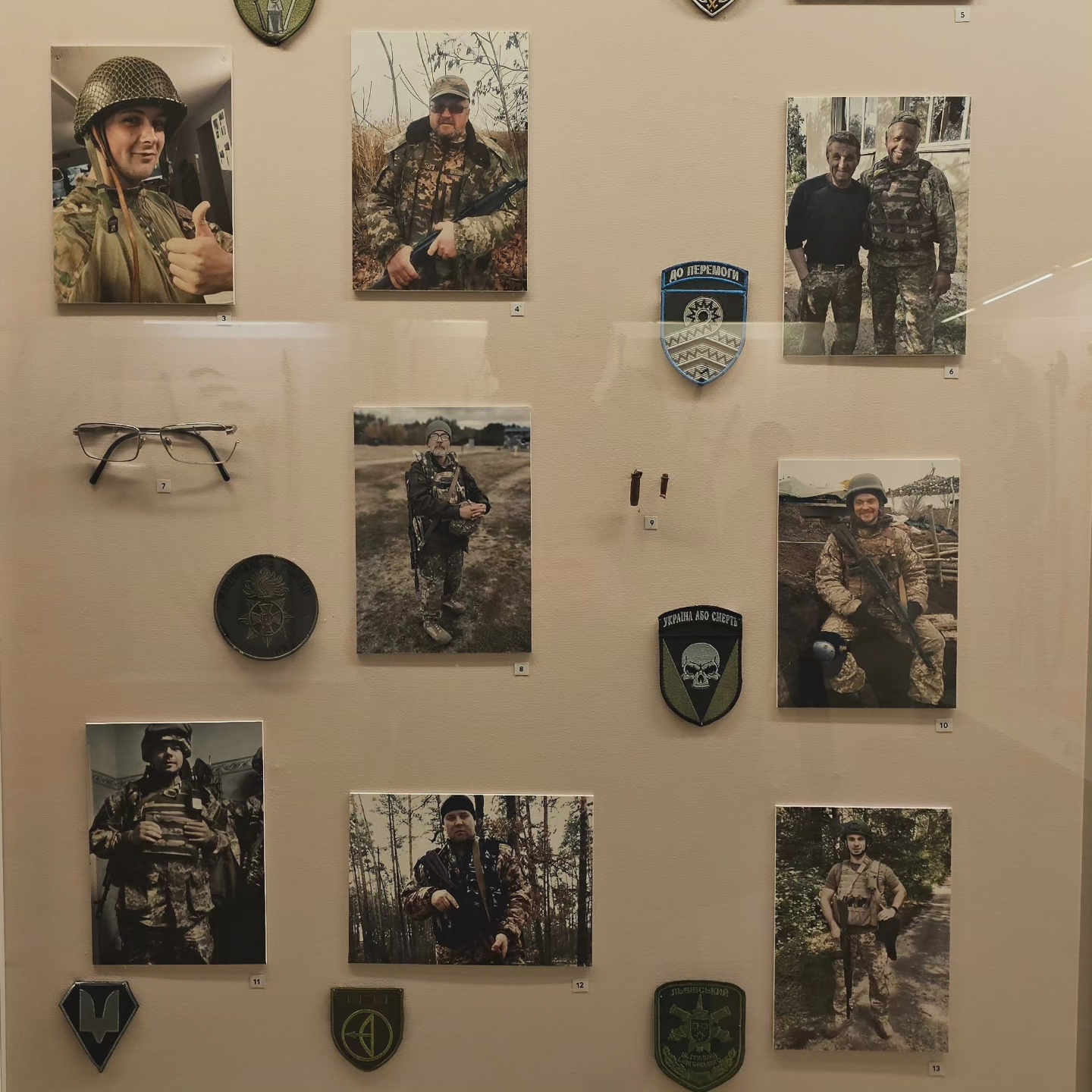
Around this chaotic and chilling display from the get-go, the museum’s aisles are another display of the contemporary. Next to mosaics and painting replicas of the Tithe and St Sophia churches, exhibitions show Ukraine interrupted in its identity quest. Because “in a museum as in life, ugliness and beauty coexist side by side”, dresses from acclaimed fashion designer Serhiy Yermakov are on show just next to a retrospective on weaponry used by Ukraine to defend its territory. Next to javelins from the 5th century BCE, cossack mases and spears from the 16th-17th centuries, and small weaponry used by nationalist groups of the beginning of the 20th century, a window reminds the visitor that blood continues to flow in what historian Timothy Snyder called a bloodland: there, pictures of the museum’s employees who joined the Ukrainian army last year are displayed. All pictures show men and women in their fatigues, and short biographies attest that this war is very much that of civilians having taken up the arms. Like in 1914, they too fight in muddy trenches, and witness the butchery.

There is Volodymyr Kolybenko, director of the Ancient History department, and Oleksandr Khomenko, director of the section devoted to the short-lived Ukrainian Republic of 1917-1921. His broken glasses are exhibited too. Anatolii Barannik and Karine Kotova, senior researchers, technician Volodymyr Kruchok, engineer Hryhorii Buhaiets, and the museum’s janitor, Viktor Vovk, is also there. Those are no longer the keepers of a history displayed behind glasses. They are the safeguard of their country’s independence.

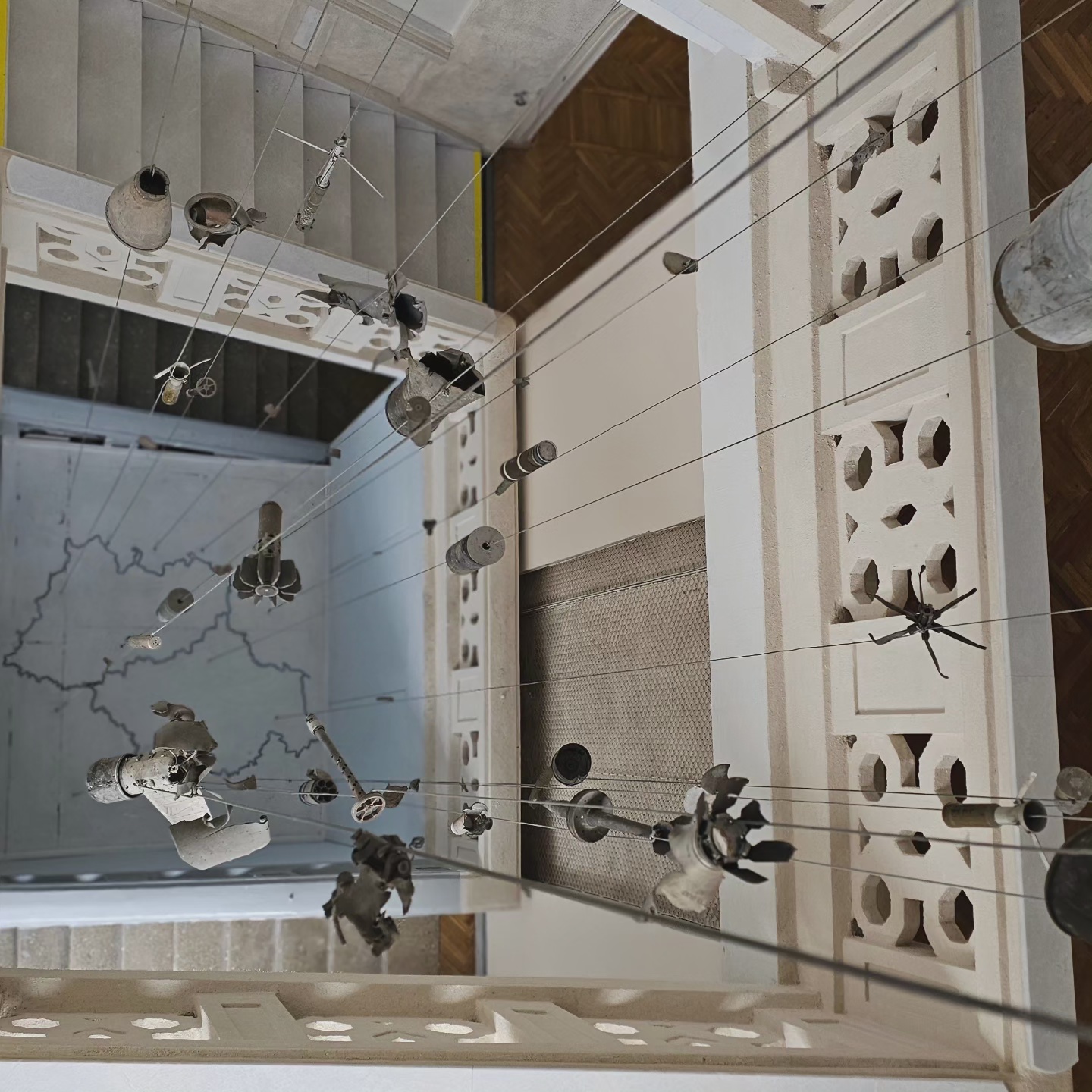
In the upper floors, the presence of war overflows even the staircase, where suspended shrapnels and explosive devices overlook a map drawn on the floor.

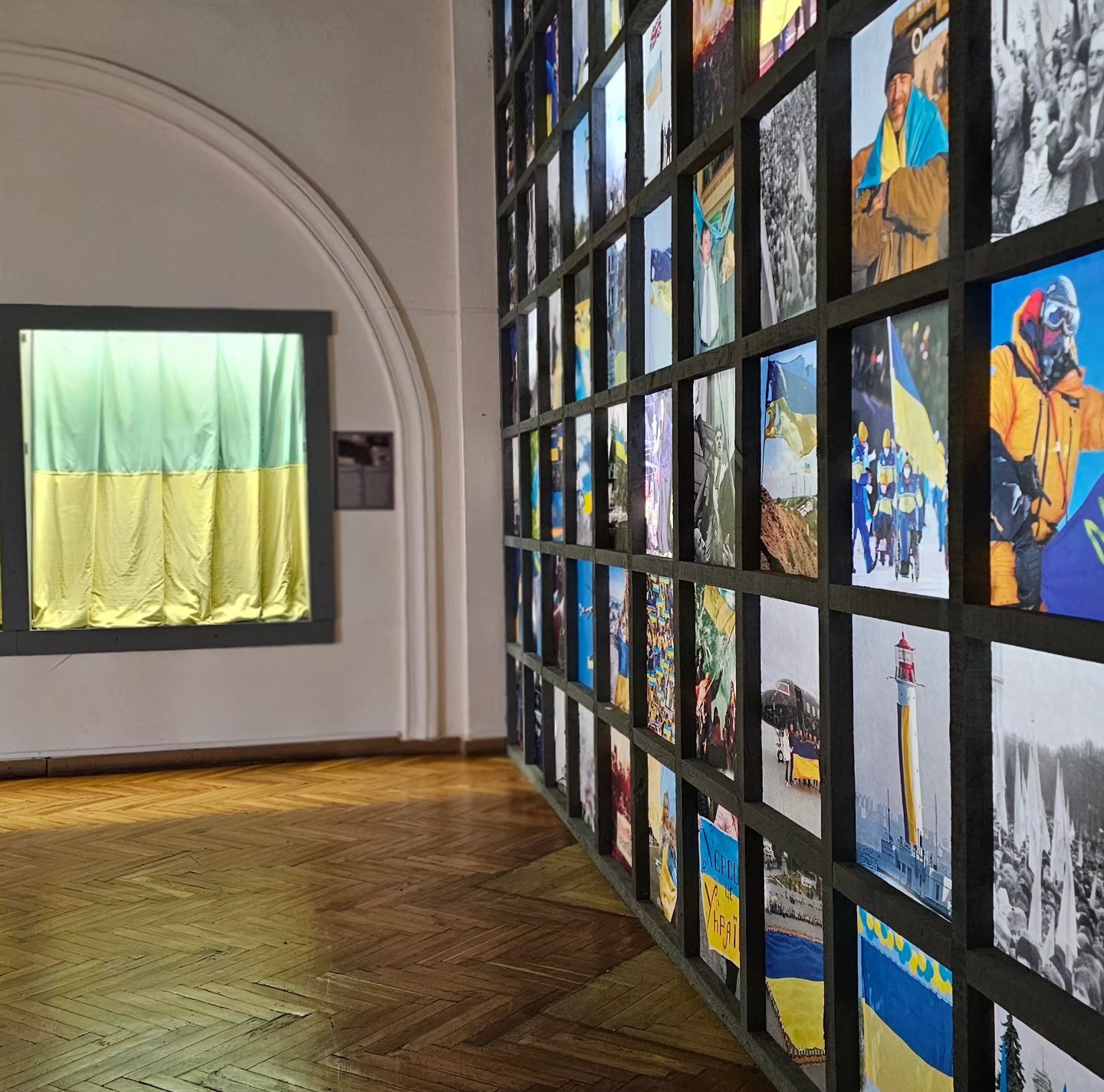
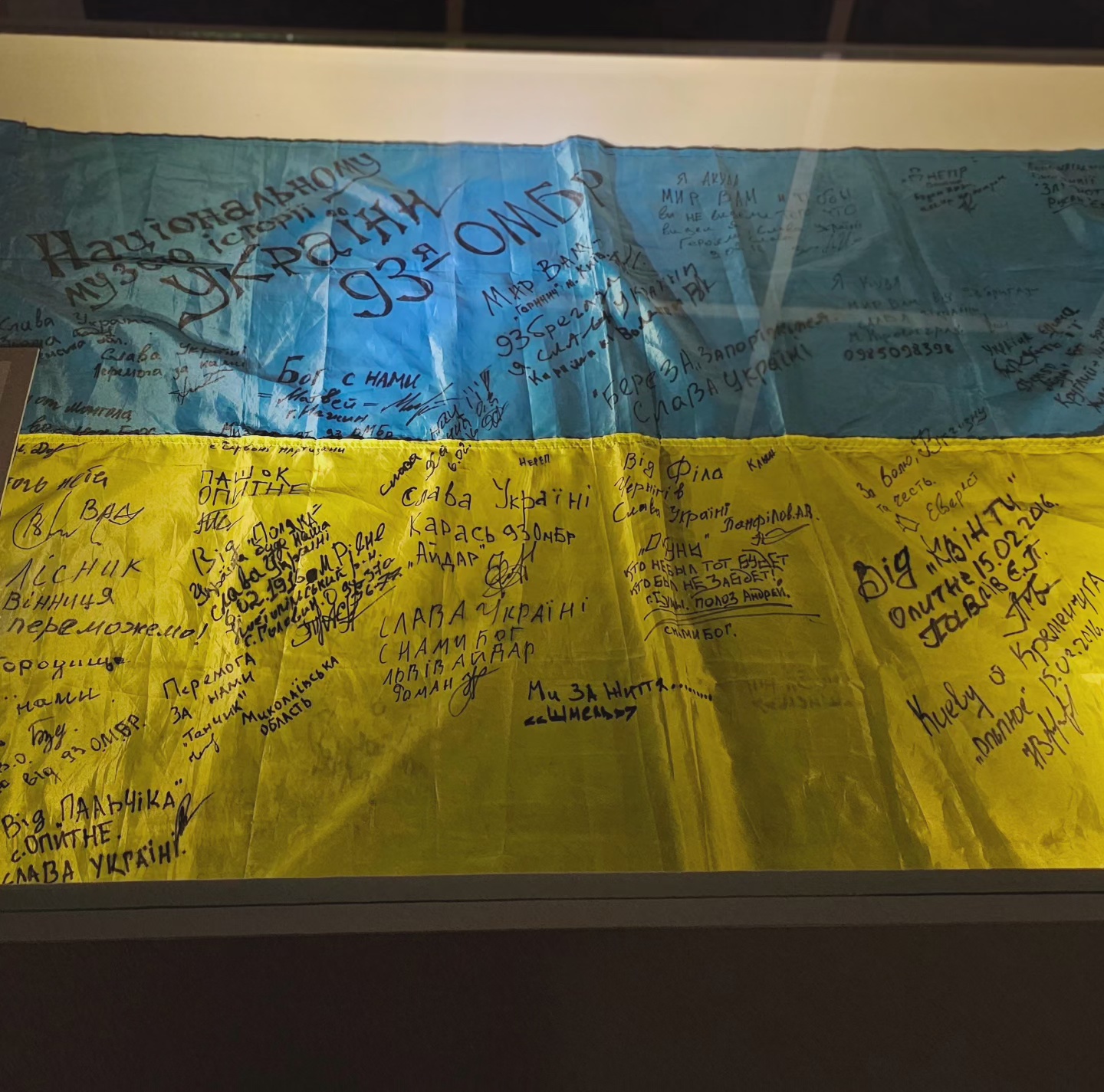
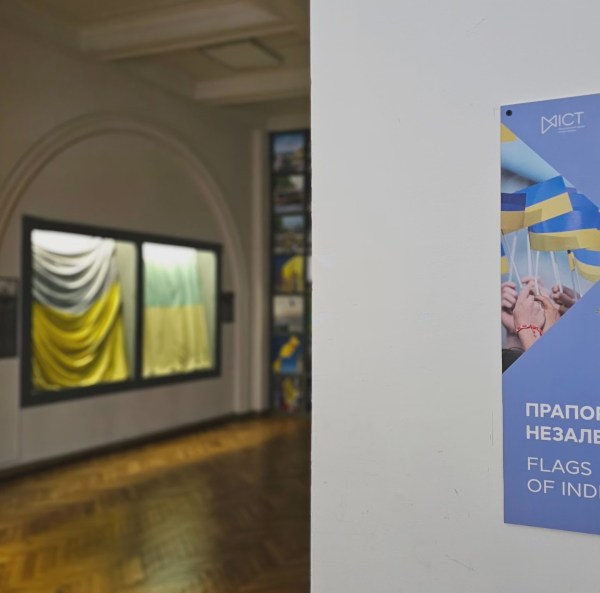
One floor up and the metallic grey is replaced by a flow of blue and yellow colours. Here, the Ukrainian flag is on display. That flag represents the fertile soil and the glorious sky, symbols of independence and freedom. Washed out but majestuous, there are two giant flags flown over public buildings in Kyiv and Lviv in 1990, during the fall of the USSR, next to a mosaic of pictures showing the flag in all its states, and during various events that shaped Ukraine’s history. To those of polar expeditions and Eurovision song contexts, are added the flag soaked in the blood of Nazaziy Voitovych, a 17 year olf student from Ternopil killed in February 2014 when he came to Kyiv to protest against the corrupt pro-Russian regime, and the flag signed by the mythical brigade 93, who defended Donetsk Airport for months during the Second Battle there, despite being under siege and attack until the beginning of 2015 and the fall of Donetsk.

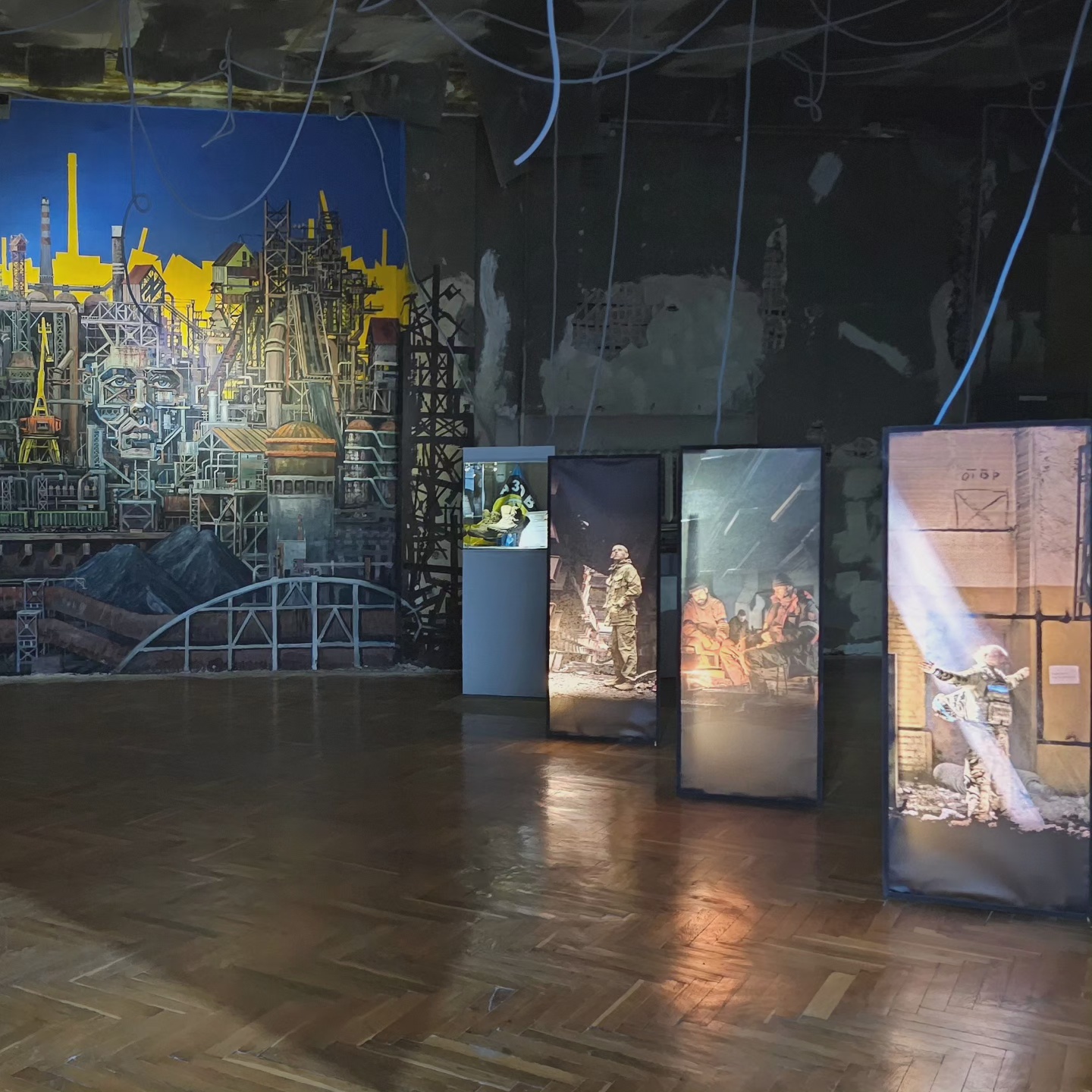
The colours of the flag stand in sharp contrast with the darkness that engulfs the museum’s last floor. There, it is time for contemplation. This is where the fight and resistance of the Azov Bataillon in Mariupol are recollected. Right at the entrance, the sight is dizzying: on four walls, lines upon lines of names and pictures remind ad infinitum the price paid by Ukrainians in the war. Mostly men, mostly young, in any case too young to not live. Candles and flowers show the grief of the hundreds of families mourning one of theirs.

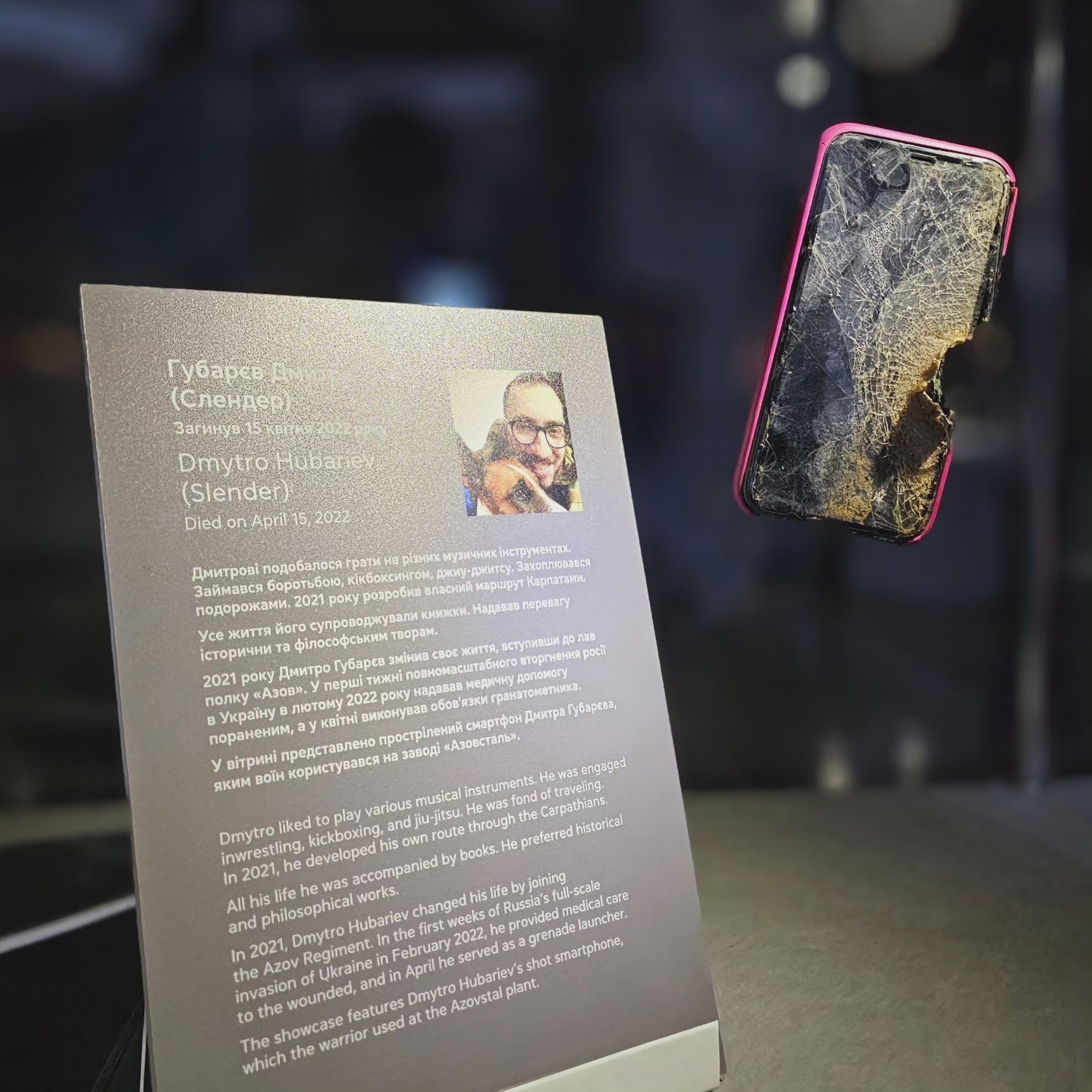
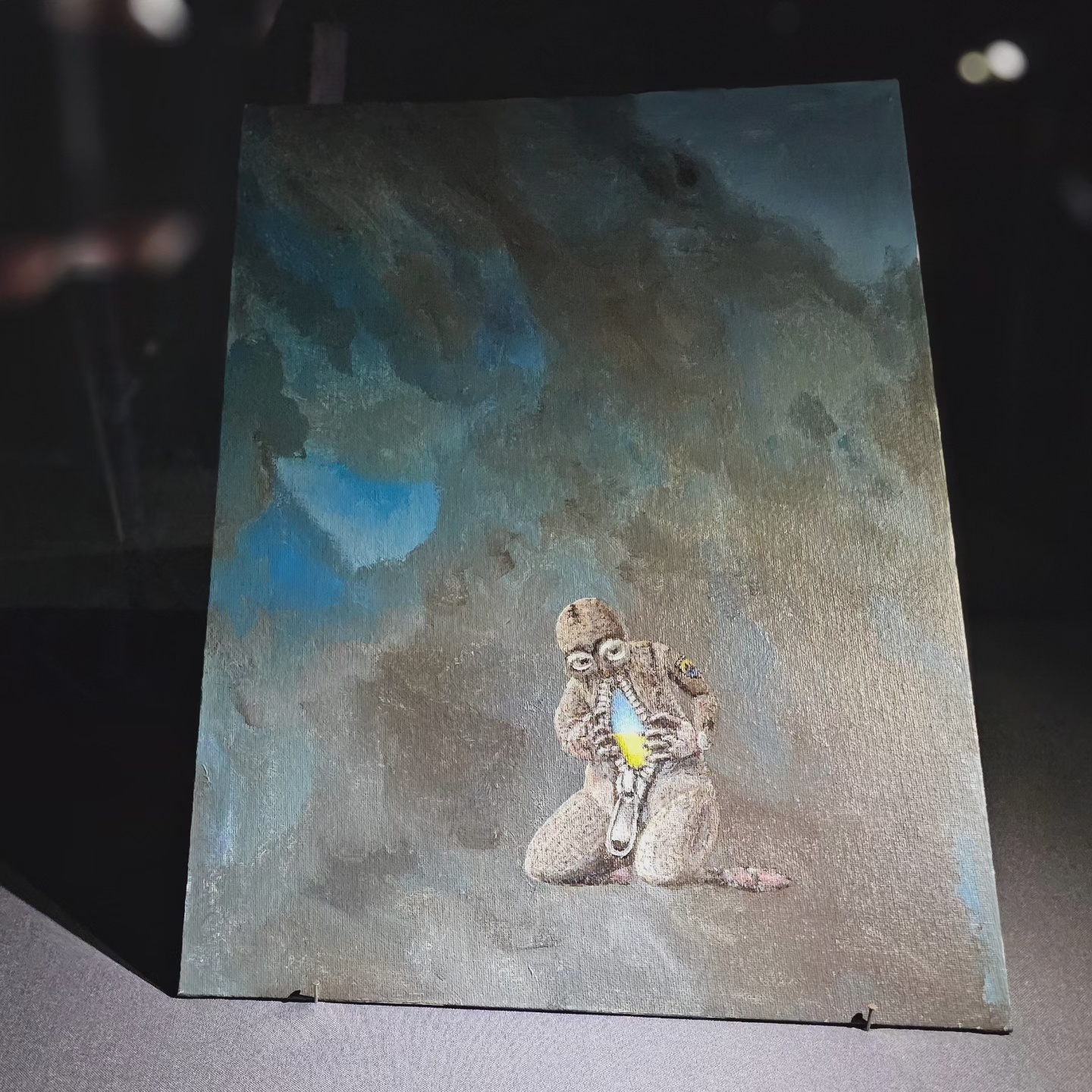
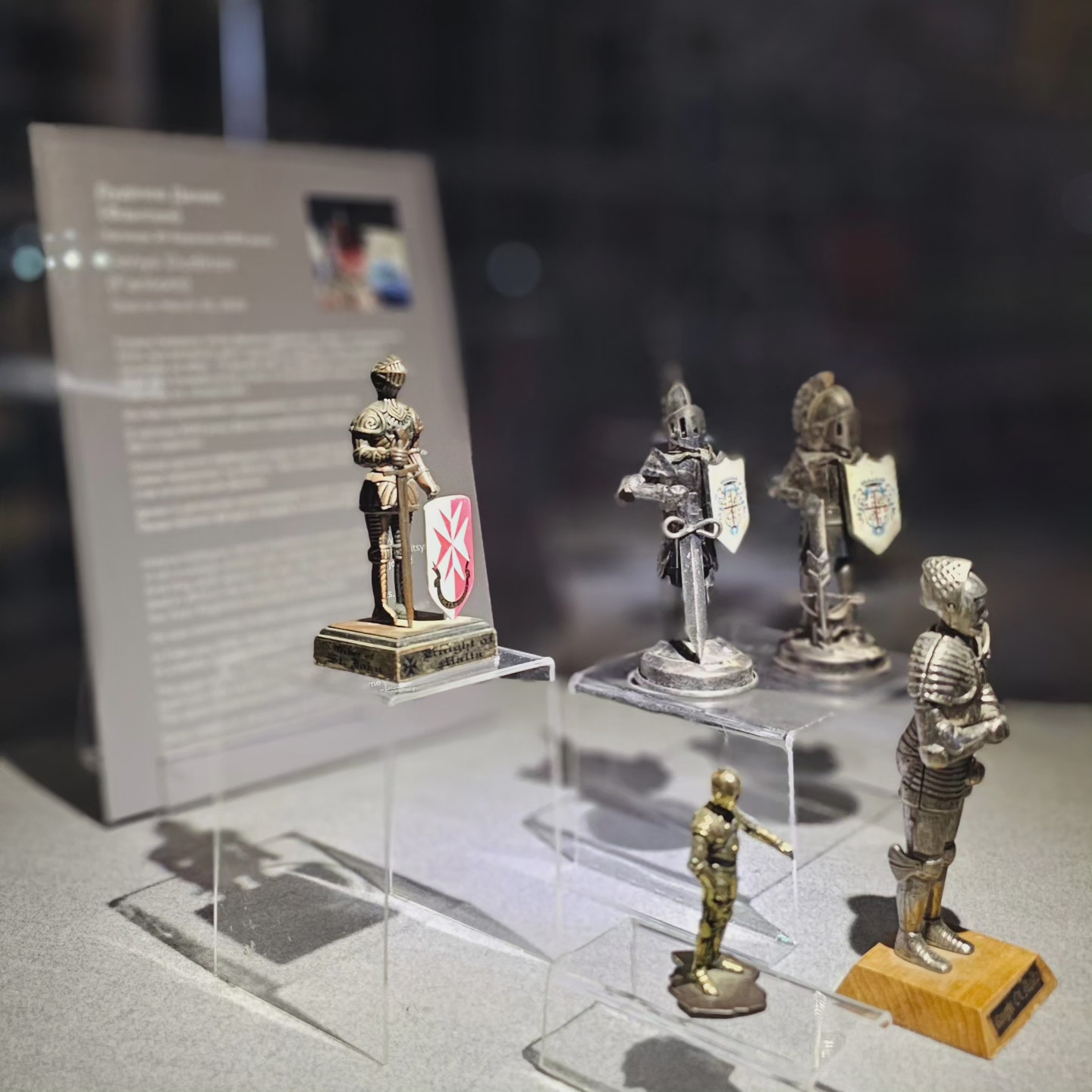
Finally, in the shadows, the history of the Azovstal factory is punctuated by lightshafts, in which belongings of fallen soldiers remind the humanity of those who died for their land. A set of figurine knights belonging to Denys Dudinov, namecode “Ghost”, the second of two brothers who died on the frontline, in his native Donetsk region, a drawing from Stanislas Kovshar, namecode “Bard”, the smashed phone of Dmytro Hubraiev, namecode “Slender”. Medals, boxing gloves, pairs of shoes…all are signs of lives interrupted by the Russian agression.

While the Ukrainian governement refuses, and will likely continue to do so for the duration of the war, to communicate on the number of dead on the frontline, the Museum of History displays, without any figure being necessary, the very grave significance of the human losses for generations to come. Walking through the exhibitions, the visitor can only try and understand, through past and present events, the current cycle of events. In the museum as in everyday life in Ukraine, there is no way to escape war.

Au musée de l’Histoire en cours

En plein coeur du vieux-Kyiv, juste à côté des ruines de l’Eglise de la Dîme, le premier édifice religieux en pierre du monde slave, datant du Xe siècle, se dresse le monumental musée national de l’histoire de l’Ukraine. Ses fenêtres souterraines sont comblées par des sacs de sable et des panneaux de bois, mais celles des étages ne sont même plus recouvertes d’adhésif, précaution utilisée en temps de guerre lors des bombardements. Malgré la guerre, le musée est ouvert, mais comment parler de l’histoire d’un pays lorsque l’un de ses chapitres les plus sanglants est en train de s’écrire ? Comment faire sens du chaos dans lequel le pays a été douloureusement plongé depuis 2014, et plus encore depuis le 24 février 2022 ? Depuis le début de l’invasion à grande échelle du pays des dizaines d’institutions culturelles, musées et bâtiments historiques, ont dû fermer ou déplacer leurs collections afin de préserver un patrimoine lui aussi visé et détruit par les bombes et par l’occupant russe.

Ouvrir ses portes est donc un acte de résilience, mais un acte qui ne saurait se penser sans inclure dans les collections l’histoire actuelle du pays. C’est la raison même de l’existence du musée de l’histoire de l’Ukraine. Au moment où l’identité même de l’Ukraine est menacée, dès l’entrée, le hall monumental témoigne de la violence de l’attaque russe et de l’occupation de la région de Kyiv jusqu’à début avril 2022.

Des obus, des brancards ensanglantés, des panneaux de rue mitraillés, tout comme des plaques commémorant les « Heavenly hundred », la centaine d’opposants au régime pro-russe massacrée par les milices à la solde du Kremlin lors de la Révolution de Maidan en février 2014, grevées d’impacts de balles échangées pendant les combats autour de Kyiv. Des effets personnels des soldats ennemis, attestant de la vétusté (atlas des routes ukrainiennes datant des années 1970, utilisé pour planifier l’invasion totale de 2022), de la brutalité de l’occupation (transcriptions d’extraits de conversations de soldats russes et de leurs proches, légitimant le viol des femmes ukrainiennes), et une bonne dose d’incongruité (l’invasion, oui, mais seulement avec des soldats à jour de leurs vaccinations, quadruplement vaccinés contre le Covid à l’aide du vaccin Sputnik).

Autour de ce chaos d’entrée de jeu,  les ailes du musée témoignent de la contemporanéité de la violence, dans un pays attaqué alors qu’il était en pleine renaissance identitaire. Dans l’aile gauche, deux expositions : celle de robes choisies d’un grand nom de la mode ukrainienne Serhiy Yermakov, car “au musée comme dans la vie, la laideur et la beauté coexistent », et juste à côté, une rétrospective d’armes, de la préhistoire à nos jours, utilisées par l’Ukraine pour défendre son territoire. A côté des javelins du 5e siècle avant J.-C., masses et lances cosaques des 16e et 17e siècles, en passant par les armes utilisées par les groupes nationalistes du début du 20e siècles, une vitrine rappelle que le sang continue de couler pour l’indépendance de l’Ukraine. Y sont représentés ceux du personnel du musée ayant rejoint l’armée ukrainienne après février 2022. Les photos se ressemblent : des hommes et des femmes en uniforme kaki, et de courtes biographies qui témoignent de cette foule de civils venus grossir les rangs de ceux qui se battent, comme en 1914, dans des tranchées boueuses depuis 22 mois.

Il y a Volodymyr Kolybenko, directeur du département d’histoire ancienne, et Oleksandr Khomenko, directeur de la section du musée consacrée à l’éphémère rêve d’une république ukrainienne des années 1917 à 1921. Ses lunettes aux verres cassés dans les combats sont également exposées. Anatolii Barannik et Karine Kotova, tous deux chercheurs, un technicien, Volodymyr Kruchok, un ingénieur, Hryhorii Buhaiets, et le concierge des lieux, Viktor Vovk. Ceux-là ne sont plus les gardiens d’une histoire présentée en vitrine aux visiteurs. Ils sont garants de l’indépendance de leur pays.

Dans les étages, le poids de l’agression déborde jusque dans la cage d’escalier, où des mobiles composés de toutes sortes d’obus et roquettes récupérées depuis 2014 sont suspendus, dans les airs et dans le temps, au-dessus d’une carte de l’Ukraine dessinée en ligne noire sur le sol blanc.

A l’étage, le gris du métal des obus laisse place à des éclats de bleu et de jaune : il est question ici du drapeau ukrainien, celui qui représente la terre fertile et le ciel bleu éclatant, symbole d’indépendance et de liberté. Délavés mais monumentaux, les deux drapeaux géants affichés sur les édifices publics de Kyiv et de Lviv en 1990, bordent une mosaïque de photos du drapeau, tour à tour flamboyant ou déchiré, au gré des événements de l’histoire du pays. A ceux des expéditions polaires et de l’Eurovision remporté en 2004 par la chanteuse Ruslana, s’ajoutent un drapeau maculé de sang, utilisé pour recouvrir le corps de Nazariy Voitovych, un étudiant de 17 ans tué lors de la révolution de Maidan en février 2014, et le drapeau signé par la mythique brigade 93, celle qui a résisté des mois durant au siège de l’aéroport de Donetsk avant la prise de la ville par l’agresseur russe début 2015.

Les couleurs du drapeau contrastent avec l’obscurité du dernier étage, transformé en espace de recueillement : c’est ici que le combat du bataillon Azov à Mariupol, dans les entrailles de l’usine Azovstal, est retracé. D’entrée, on a le vertige : sur quatre murs, des rangées de photos et de courtes biographies s’étalent, à l’infini. Des hommes, souvent jeunes, quelques femmes : le bataillon a payé un lourd tribu en vies humaines à Mariupol. Des bougies et quelques bouquets rappellent les familles éplorées que ces soldats ont laissé derrière eux.

Enfin, dans la pénombre, l’histoire de l’usine Azovstal se mêlent à quelques puits de lumière, dans lesquels quelques effets personnels de soldats décédés viennent rappeler l’humanité de ceux morts pour leur patrie : il y a la collection de figurines de chevaliers d’un certain Denys Dudinov, nom de code « Fantôme », le second de deux frères à mourir au front, dans sa région natale de Donetsk, en mars 2022, un dessin du père de Stanislas Kovshar, nom de code « Barde », le téléphone en miettes de Dmytro Hubariev, nom de code « Mince », tous deux morts en avril 2022. Des médailles, des gants de boxes, des paires de chaussures, sont autant de témoins des vies interrompues par l’invasion russe. Alors que le gouvernement ukrainien refuse, et refusera sans doute jusqu’à la fin de la guerre, de dévoiler le nombre de morts dans les rangs de l’armée, le musée d’histoire de l’Ukraine rend compte, sans que des chiffres soient nécessaires, de la gravité de ces pertes en vies humaines pour des générations à venir. Au gré des expositions, reste à ceux qui vivent de tenter de comprendre, par le passé et le présent, le cycle des événements actuels. Au musée comme au quotidien en Ukraine, il n’y a pas d’échappatoire à la guerre.

Website Powered by WordPress.com.

Up ↑